Data-Center Waste Heat and Unused Thermal Energy
Heat removed from electronics does not have to be rejected; it can be upgraded, stored, and reused.
Most of the electrical power consumed by a data center eventually becomes heat. Air cooling often rejects that heat at relatively low temperature, while liquid cooling makes it easier to recover heat at a more useful temperature level.
We therefore treat data-center cooling and heat utilization as connected problems rather than stopping once the electronics have been cooled.
Research focus
- Heat recovery from liquid-cooled data centers
- Temperature upgrading with heat pumps
- Thermal storage, Carnot batteries, and adsorption
- Hot water, space heating, and industrial heat use
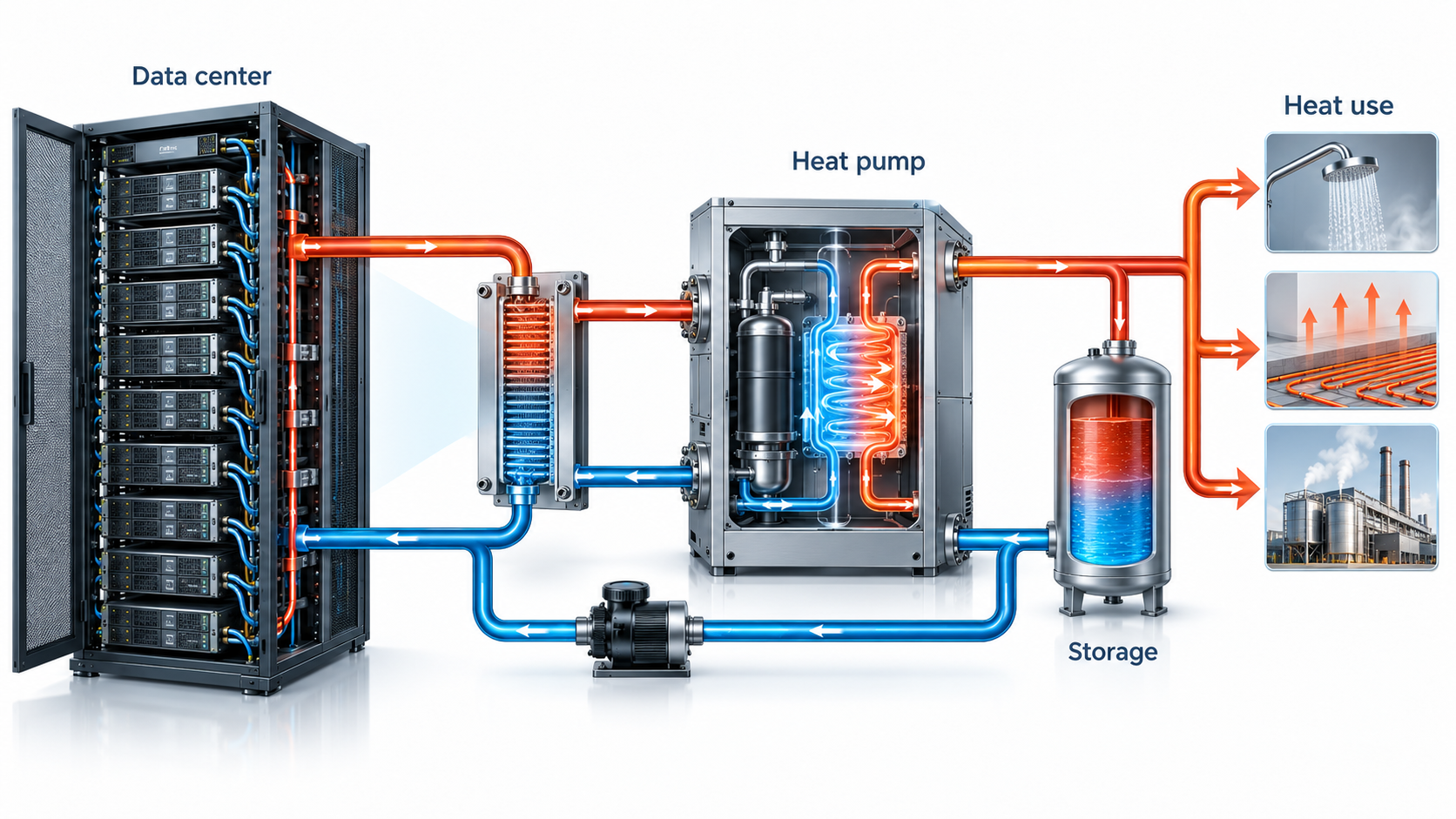
Recovering heat from liquid cooling
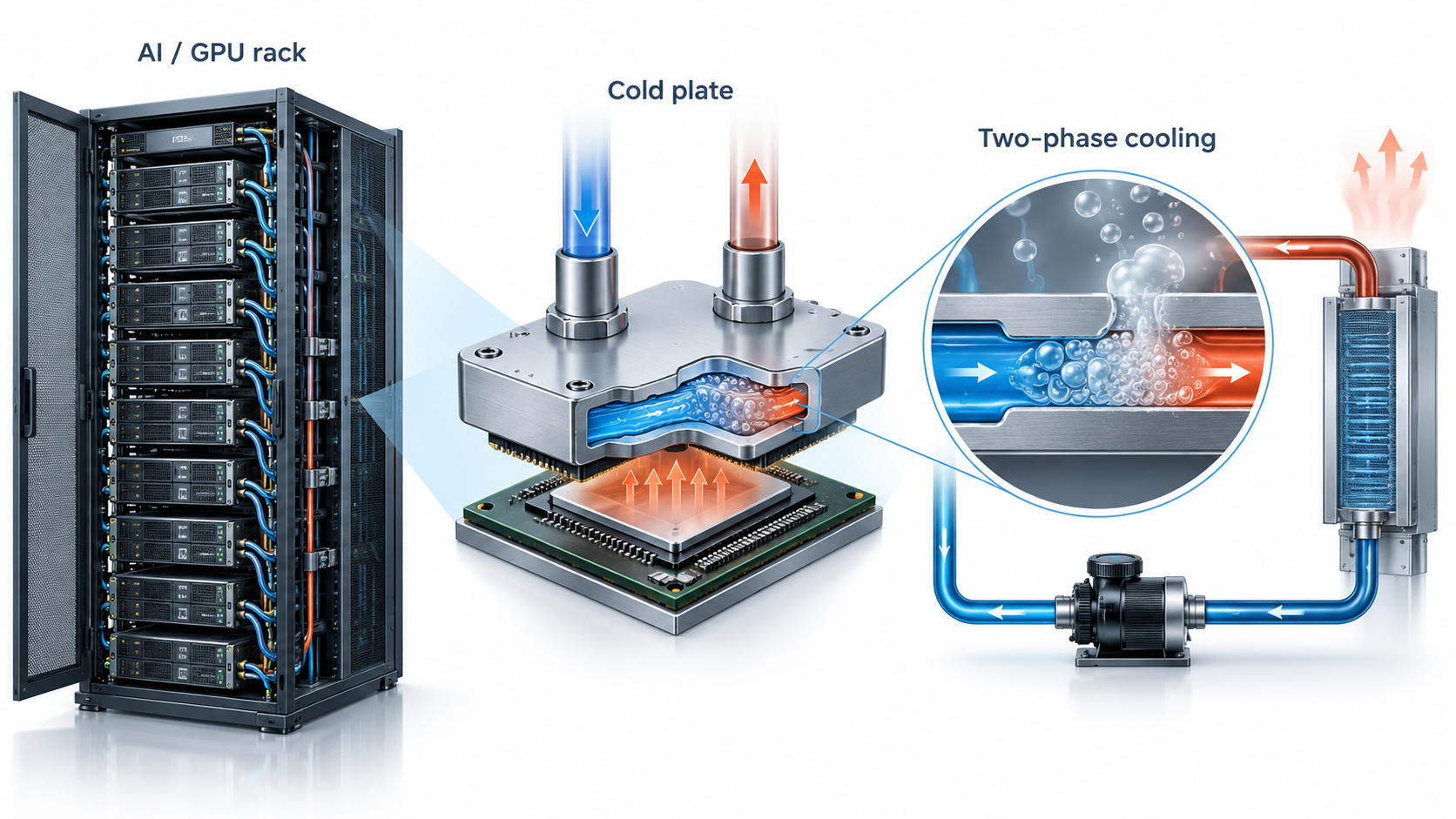
Heat transferred from CPUs and GPUs to a liquid loop can be collected instead of discharged directly to the ambient. The cooling system must still protect the electronics, but a higher recovery temperature can make downstream heat use much more practical.
Upgrading temperature with a heat pump
When the recovered temperature is too low for the intended use, a heat pump can raise it. For hybrid air/liquid-cooled data centers, we have also examined systems that recover two different source-temperature levels at two evaporating temperatures.
Connecting storage and demand
Data centers generate heat continuously, whereas hot-water and heating demand vary over time. We therefore study latent thermal storage, Carnot batteries, adsorption, and desiccant materials as ways to bridge this mismatch.
Next directions
Future work includes thermoresponsive materials and adsorption heat exchangers for connecting data-center waste heat to district or industrial heat use. The cooling side and the heat-use side should be designed as one thermal system rather than optimized independently.
Selected related work
- Ce Zhang et al., “Dual evaporating temperature steam generation heat pump system for waste heat recovery of air-liquid hybrid cooling data center,” Energy Conversion and Management (2026).
- Ce Zhang et al., “Feasibility analysis of multi-mode data center liquid cooling system integrated with Carnot battery energy storage module,” Energy (2025).
- Ce Zhang et al., “Enhanced Carnot battery for high-efficiency energy storage: Feasibility analysis,” Energy Conversion and Management (2025).
Publication list »