Next-Generation Cooling for AI and Data Centers
We study how boiling can be used stably when single-phase liquid cooling reaches its practical limits.
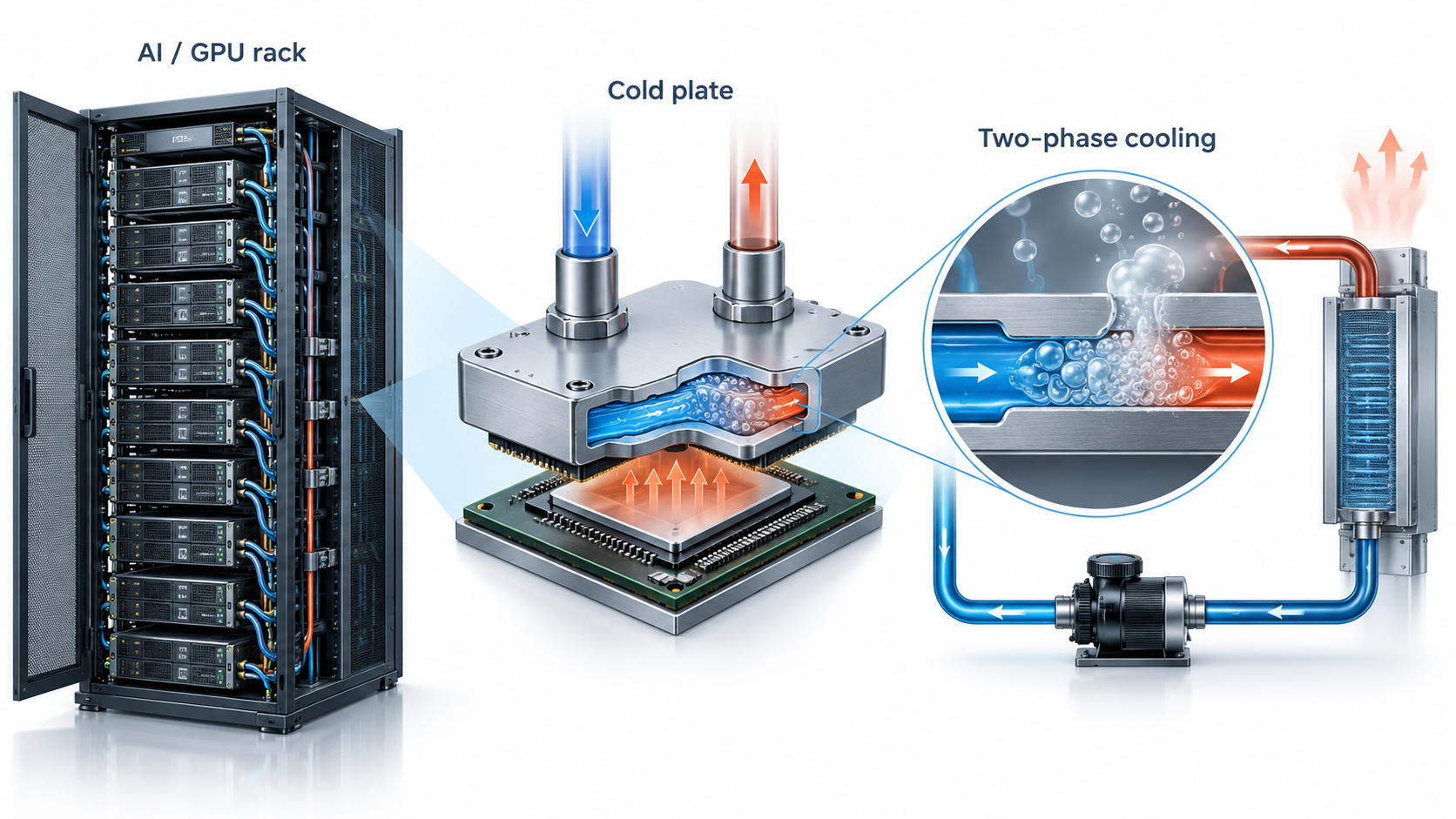
The heat load of AI servers is rising as CPUs and GPUs become more powerful and more densely packed. Direct liquid cooling with cold plates is now widely adopted, but simply increasing liquid flow eventually brings higher pumping power and larger temperature non-uniformity.
Our work therefore focuses on two-phase cooling, where boiling latent heat is used deliberately. The key is not to avoid boiling, but to make the flow and phase change stable and predictable.
Research focus
- Two-phase cold plates for high-power CPUs and GPUs
- Low pressure drop and backflow suppression with expanding channels
- Series and parallel operation of multiple cold plates
- Two-phase inlet conditions, immersion cooling, and 3D-package cooling
Radially expanding-channel cold plates
In our expanding-channel design, the flow area increases from inlet to outlet. This provides more space for the growing vapor volume as boiling proceeds and helps reduce pressure drop and backflow.
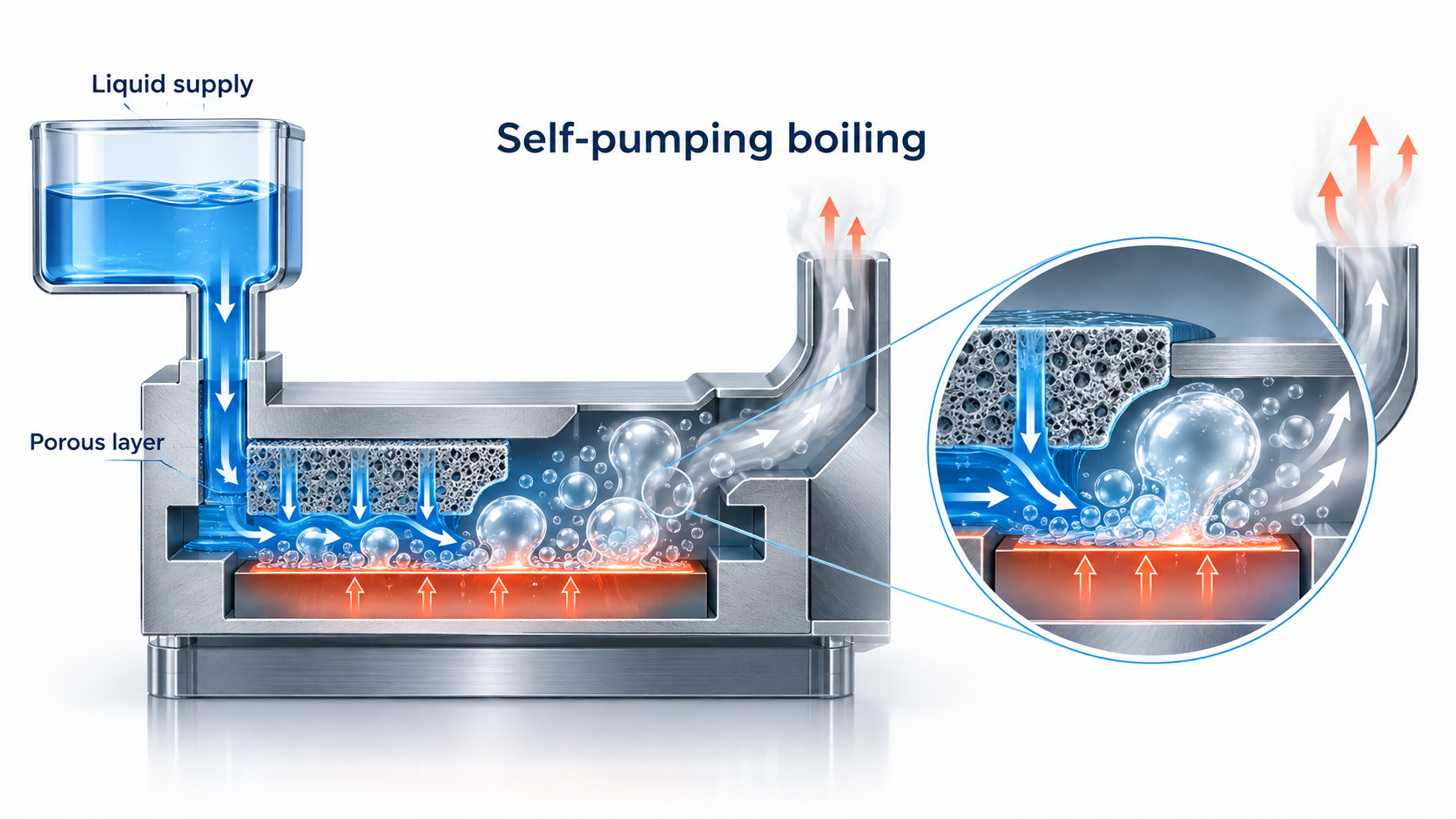
We have studied low-flow-inertia conditions, two-phase inlet conditions, and three-dimensional liquid supply structures using porous media.
Cooling multiple CPUs and GPUs
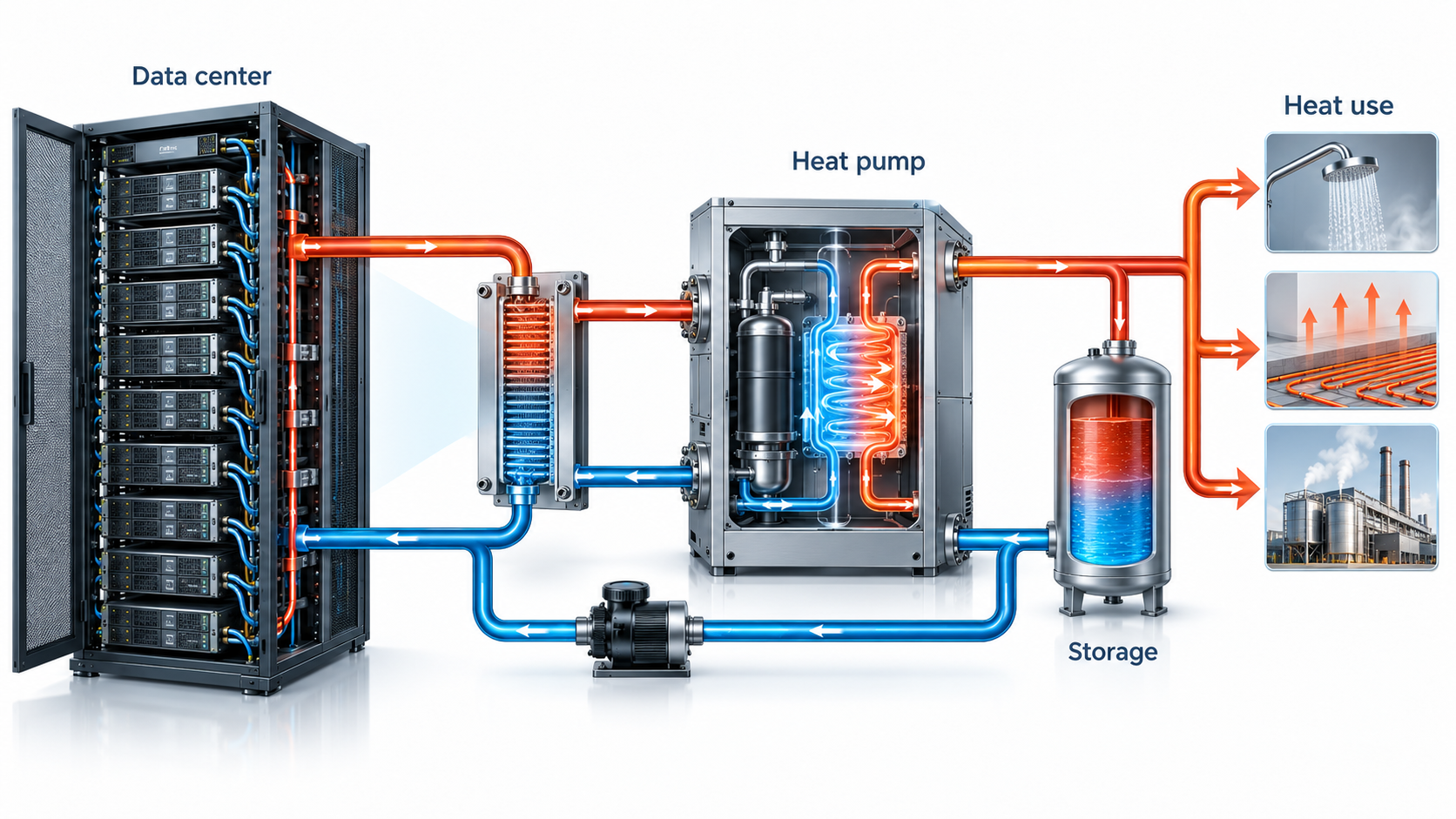
A real data-center loop contains many heat sources. When cold plates are connected in series or parallel, flow distribution and the vapor generated upstream can strongly affect downstream performance.
Current work examines the stability and cooling performance of multiple cold plates as a coupled system rather than as isolated devices.
Next directions
Beyond two-phase cold plates, we are also studying dielectric immersion cooling, local cooling inside 3D semiconductor packages, and three-dimensional liquid supply using porous structures. The aim is to select and combine cooling methods according to heat flux and package architecture.
Selected related work
- Sihui Hong et al., “Experimental research on cooling performances of radial expanding-channeled heat sinks applied for multiple heat sources,” Applied Thermal Engineering (2023).
- Zhengyong Jiang et al., “Experimental study on flow boiling of two rectangular expanding microchannel heat sinks in series connection and flow patterns analysis,” International Communications in Heat and Mass Transfer (2024).
- Sihui Hong, Chaobin Dang, Eiji Hihara, “Experimental investigation on flow boiling characteristics of radial expanding minichannel heat sinks applied for two-phase flow inlet,” IJHMT (2020).
Publication list »