Research Overview
This study focuses on functional surfaces that combine superhydrophobicity and photothermal conversion. The surfaces were experimentally evaluated in terms of icing delay, photothermal ice melting, and rapid deicing under low-temperature conditions. The findings suggest a promising route toward low-energy auxiliary defrosting for electric vehicle heat pump heat exchangers.
Graphical Abstract
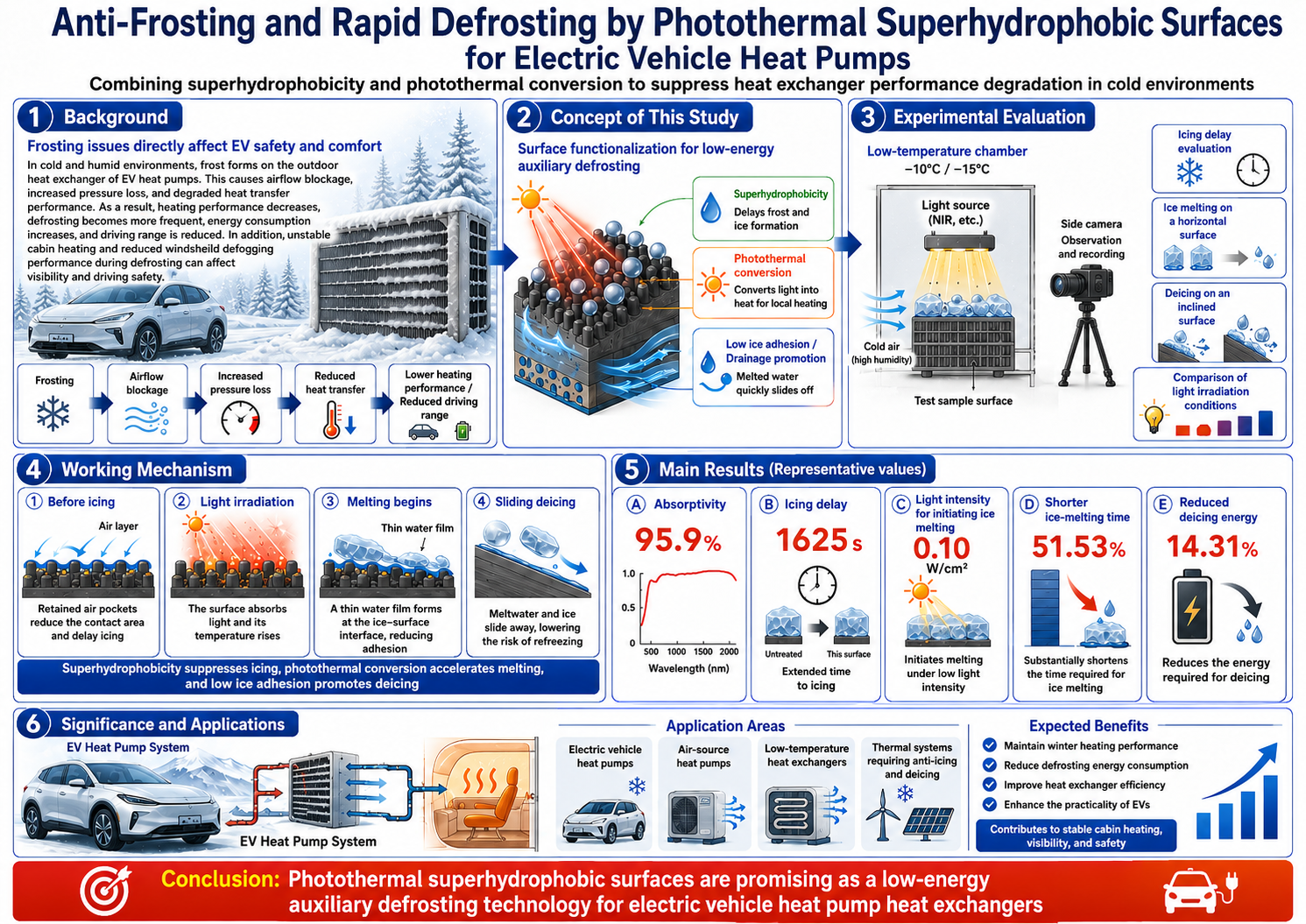
Figure: One-page summary of the application background, concept, experimental evaluation, working mechanism, representative results, and potential applications of photothermal superhydrophobic surfaces for EV heat pump defrosting assistance.
Background and Objective
In cold and humid environments, frost forms on the outdoor heat exchanger of electric vehicle heat pumps. Frost accumulation blocks air flow passages, increases pressure loss, and deteriorates heat transfer performance. As a result, heating performance decreases, defrosting becomes more frequent, energy consumption increases, and driving range is reduced.
In addition, unstable cabin heating and reduced windshield defogging performance during defrosting may affect cabin comfort, visibility, and driving safety. Therefore, low-energy auxiliary defrosting technologies that can remove ice and frost rapidly and locally are required.
Features of This Study
- Superhydrophobicity: Reduces the contact area between droplets and the solid surface, thereby delaying icing.
- Photothermal conversion: Converts incident light into heat and locally warms the surface to promote ice melting.
- Low ice adhesion: Promotes the formation of a thin water film at the ice–surface interface and reduces adhesion.
- Drainage promotion: Helps melted water and ice slide off the surface, reducing residual water and refreezing risk.
- EV application: Aims to support heat exchanger performance, reduce defrosting energy, and improve visibility and safety.
Proposed Method and Working Mechanism
1. Before icing
The microstructured surface retains air pockets, reducing the contact area between the droplet and the solid surface. This delays icing under low-temperature conditions.
2. During light irradiation
The photothermal function converts incident light into heat. Local surface heating promotes the initiation of ice melting.
3. When melting begins
A thin water film forms at the ice–surface interface. This changes the interface from strong solid–solid adhesion to a more slippery water-mediated state, reducing ice adhesion.
4. During deicing
Once adhesion is reduced, meltwater and ice can slide off the surface more easily. This lowers the risk of residual water and refreezing. By combining icing delay and active photothermal melting, the surface enables rapid deicing with reduced energy input.
Key Findings
Future Prospects
The photothermal superhydrophobic surface demonstrated in this study is promising as an auxiliary defrosting technology for electric vehicle heat pump heat exchangers. It may contribute to maintaining winter heating performance, reducing defrosting energy consumption, improving heat exchanger efficiency, and suppressing driving-range reduction.
Future work should consider actual heat exchanger geometries, airflow conditions, frost-layer growth, and long-term durability in order to further evaluate the applicability of this approach to practical EV heat pump systems.
Potential Application Areas
This technology is expected to be applicable to low-temperature thermal management systems such as:
Conclusion
Photothermal superhydrophobic surfaces can delay icing under low-temperature conditions, promote ice melting under light irradiation, and accelerate deicing through low ice adhesion. These functions make them promising as low-energy auxiliary defrosting surfaces for electric vehicle heat pump heat exchangers.
Paper Information and Link
Title: Copper-based photothermal superhydrophobic surfaces with multi-level structures for applications of anti-icing, ice-melting and rapid deicing
Journal: Applied Thermal Engineering, 292 (2026) 130286
DOI: https://doi.org/10.1016/j.applthermaleng.2026.130286
Authors: Liwei Dong, Minxia Li, Chaobin Dang, Jintao Niu, Chenxu Wang