■ Bibliographic Information
- Title: Characterization of droplet freezing on superhydrophobic surfaces with different microstructures
- Authors: Xu Han, Dan Zhang, Haikun Zheng, Wei Sheng, Xiaoru Hao, Xiaozhuan Chen, Chaobin Dang, Mengjie Song
- Journal: Energy & Buildings, Volume 327 (2025) 115109
- DOI: 10.1016/j.enbuild.2024.115109
■ Research Overview (Graphical Abstract)
Click the image to open the standard PNG overview file.
Note: This figure is an AI-generated research overview and may contain inaccuracies. Please verify numerical values, terminology, and conclusions against the original paper and the accompanying check notes.
Background and Aim
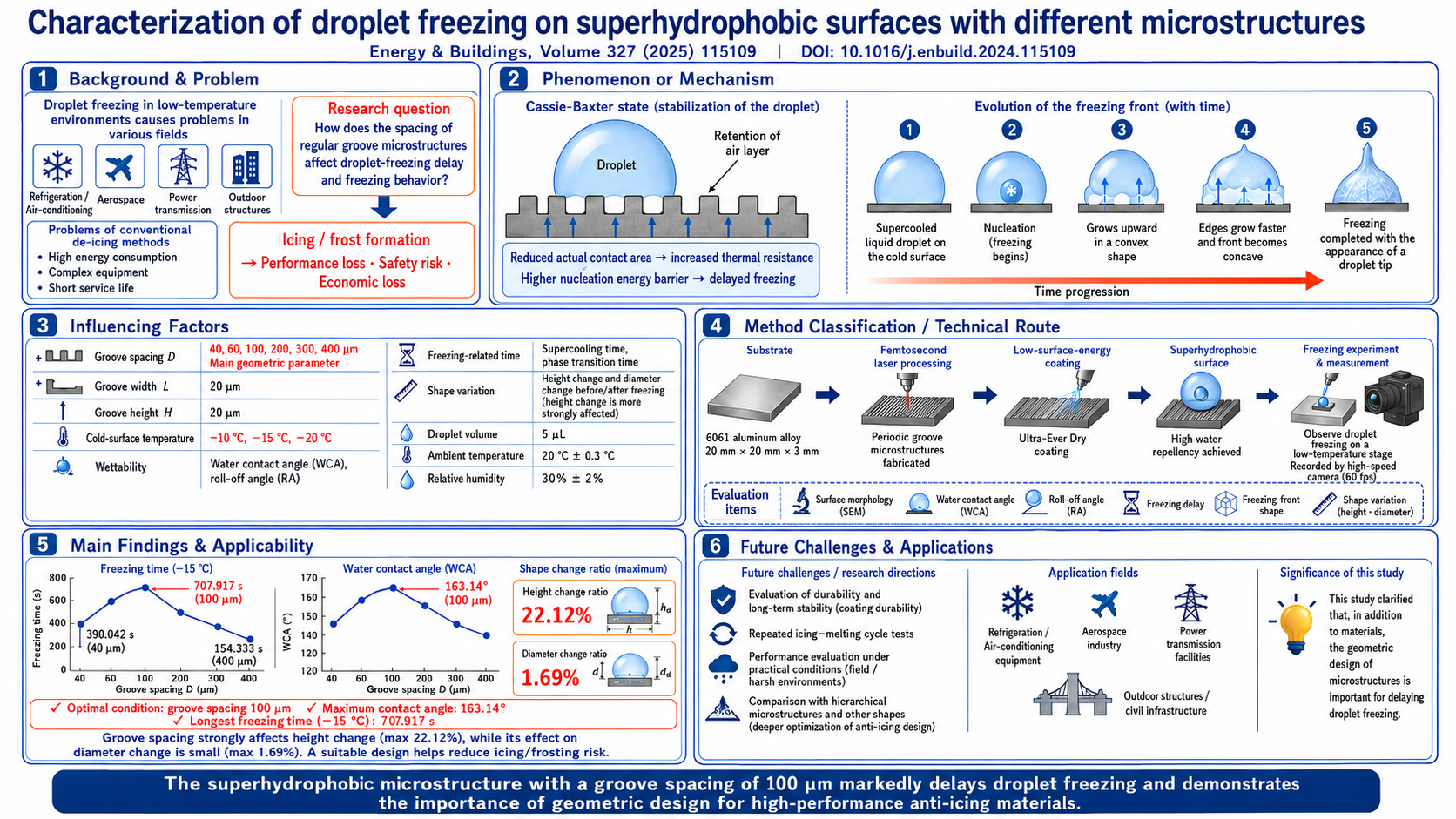
This paper studies how regular grooved microstructures affect water droplet freezing on superhydrophobic aluminum surfaces.
Methods
Groove spacings from 40 to 400 μm were fabricated by femtosecond laser processing and combined with a low-surface-energy coating. Droplet freezing time, shape change, and freezing-front motion were measured.
Main Findings
The 100 μm spacing surface showed the best anti-icing behavior, with a contact angle of 163.14° and a freezing time of 707.917 s at -15 °C. The freezing front changed from convex to concave during growth.
Contribution and Applications
The study provides a structure-design reference for anti-icing materials used in refrigeration, low-temperature equipment, and outdoor surfaces.
Summary
This study shows that a 100 μm grooved superhydrophobic microstructure markedly delays droplet freezing and clarifies the importance of microstructure spacing in anti-icing surface design.