Research Overview
This study experimentally investigates the liquid film thickness of gas–liquid Taylor flow in square and rectangular microchannels applied to microreactors. Liquid film thickness was measured using a laser focus displacement meter (LFDM), while bubble shapes and velocities were captured by high-speed visualization. The work clarifies the effects of channel hydraulic diameter, aspect ratio, capillary number, and surface tension on liquid-film distribution in air–water and Tween-20-added systems.
Graphical Abstract
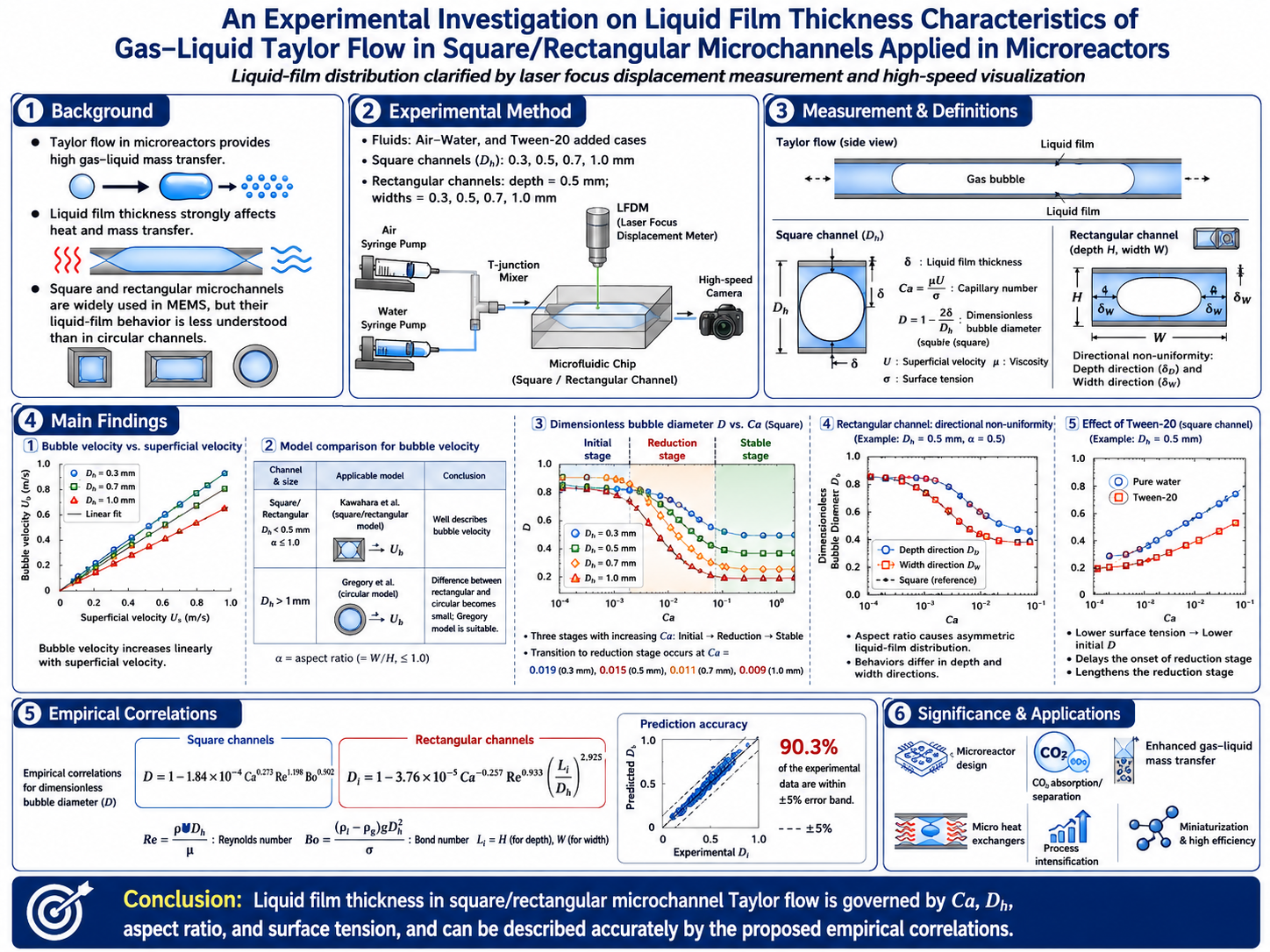
Figure: One-page summary of the research background, experimental method, measurement definitions, main findings, empirical correlations, and potential applications for microreactor design.
Background and Objective
Gas–liquid Taylor flow in microreactors provides a large interfacial area and stable segmented-flow structure, which are highly beneficial for reactions, absorption, separation, and heat and mass transfer. In processes such as CO2 absorption and chemical reactions, liquid film thickness controls the transport distance and strongly affects process efficiency.
Although liquid film thickness in circular microchannels has been widely studied, square and rectangular microchannels are more commonly manufactured in MEMS-based devices. Their corners and asymmetric cross-sections cause non-uniform liquid-film distribution, which remains insufficiently understood. This study aims to quantify the liquid-film characteristics in square and rectangular microchannels and provide reliable correlations for design.
Key Features of This Study
- High-precision measurement: Liquid film thickness around Taylor bubbles was measured non-contact using LFDM.
- Synchronized visualization: Bubble shape and bubble velocity were recorded using a high-speed camera.
- Various channel geometries: Square channels with hydraulic diameters of 0.3, 0.5, 0.7, and 1.0 mm and rectangular channels with a depth of 0.5 mm were tested.
- Surfactant effect: The influence of Tween-20 addition and reduced surface tension was evaluated.
- Empirical correlations: Dimensionless bubble diameter in square and rectangular channels was correlated using Ca, Re, Bo, and Li/Dh.
Proposed Method and Working Mechanism
1. Generation and visualization of Taylor flow
Air and liquid were supplied by syringe pumps and mixed at a T-junction to generate gas–liquid Taylor flow in microchannels. A high-speed camera was used to observe bubble shape, bubble length, and bubble velocity.
2. LFDM measurement of liquid film thickness
The inner wall position x1 was measured in an air-only state, and the gas–liquid interface position x2 was measured when a bubble passed. The liquid film thickness was calculated as δ = |x2 − x1|.
3. Dimensionless analysis of liquid-film distribution
For square channels, the dimensionless bubble diameter was defined as D = 1 − 2δ/Dh. For rectangular channels, Di = 1 − 2δi/Li was used depending on the measurement direction.
4. Development of empirical correlations
Empirical correlations were developed using dimensionless groups such as Ca, Re, Bo, and Li/Dh to describe liquid-film behavior in square and rectangular microchannels.
Main Findings
Future Prospects
This study provides reliable experimental data and empirical correlations for liquid film thickness in gas–liquid Taylor flow in square and rectangular microchannels. These results can support the design of microreactors and micro heat exchangers where heat and mass transfer strongly depend on liquid-film behavior.
Future work can further investigate the effects of fluid properties, wall contact angle, surface wettability, and channel structure on liquid-film formation and distribution.
Combining these experimental correlations with numerical simulations and reaction or absorption models will help establish practical design guidelines for high-efficiency microreactors and scale-up strategies.
Potential Applications
The findings can be applied to micro-scale reaction, separation, and heat-transfer devices using gas–liquid two-phase flow.
Summary
This study combined LFDM measurement with high-speed visualization to quantitatively measure liquid film thickness in gas–liquid Taylor flow in square and rectangular microchannels.
The results show that liquid film thickness is governed by capillary number, hydraulic diameter, aspect ratio, and surface tension, and that square and rectangular microchannels exhibit geometry-dependent non-uniformity.
Paper Information and Links
Paper title:An experimental investigation on characteristics of liquid film thickness of gas-liquid Taylor flow in square/rectangular microchannel applied in microreactor
Journal:International Journal of Heat and Mass Transfer, 234 (2024) 126081
DOI:https://doi.org/10.1016/j.ijheatmasstransfer.2024.126081
Authors:Dengwei Fu, Yifei Hu, Zhaoyu Li, Chaobin Dang, Sihui Hong