Research Overview
This study experimentally investigates nucleate boiling heat transfer of refrigerant-oil mixtures on various modified surfaces. R134a-POE and R1234ze(E)-POE mixtures were tested on five surfaces: smooth surface, initial laser-ablated surface, stabilized laser-ablated surface, machined surface, and composite processed surface. The effects of oil concentration, surface microstructure, and surface wettability on heat transfer coefficient and bubble behavior were clarified.
Graphical Abstract
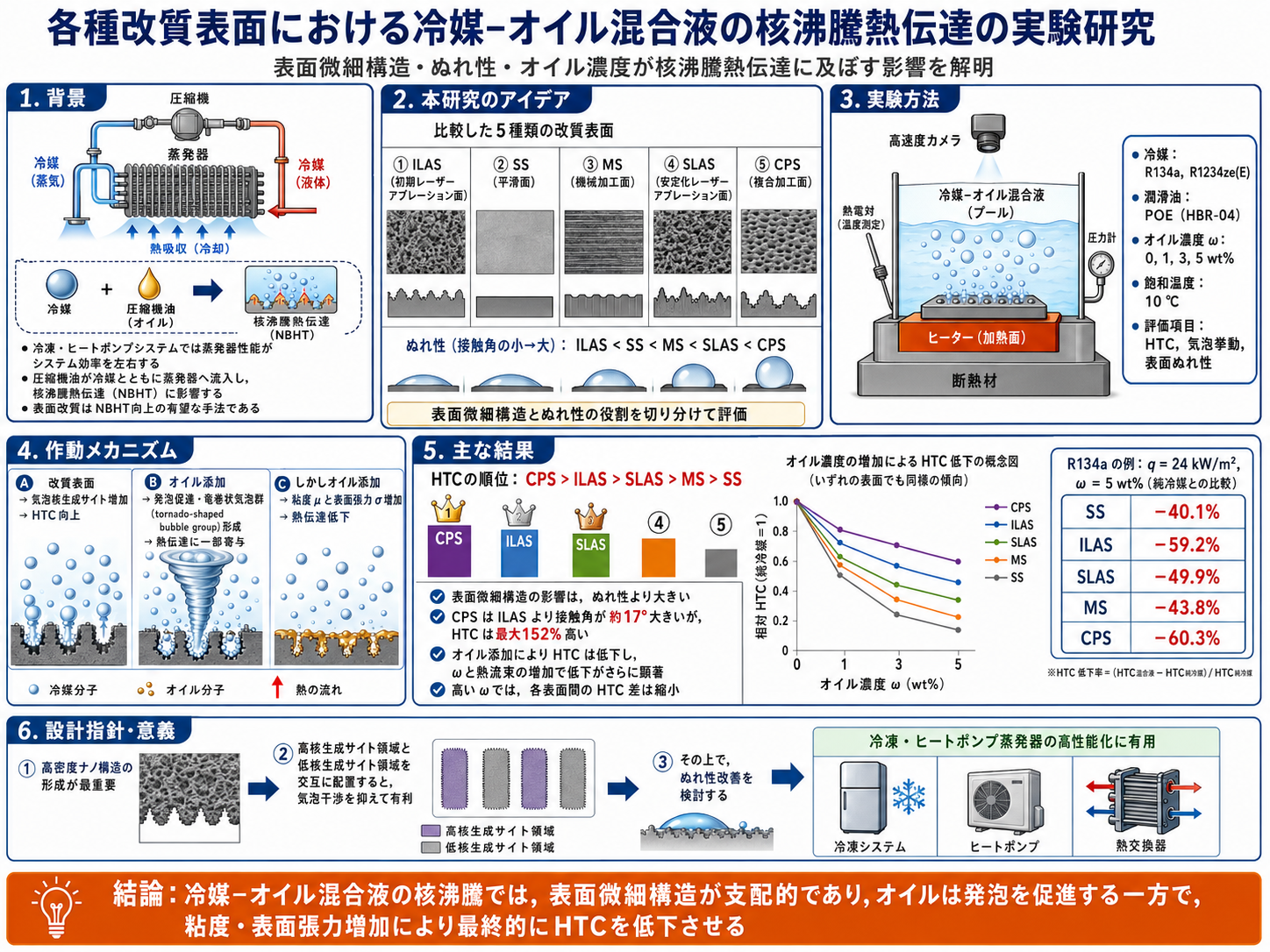
Figure: One-page graphical summary of refrigerant-oil nucleate boiling in refrigeration and heat-pump evaporators, five modified surfaces, pool boiling experiment, oil concentration, wettability, surface microstructure, bubble behavior, HTC variation, and heat exchanger design guidance.
Background and Objective
In refrigeration and heat pump systems, evaporator performance directly affects system efficiency. Lubricating oil used in compressors inevitably circulates with the refrigerant and enters the evaporator.
Lubricating oil changes refrigerant properties, bubble nucleation, bubble growth, bubble departure, wall wettability, and local thermal resistance. Therefore, evaporator design based only on pure refrigerant may deviate from real system performance.
The objective of this study is to clarify whether surface microstructure or surface wettability plays a more dominant role in nucleate boiling heat transfer of refrigerant-oil mixtures and to provide design guidance for modified evaporator surfaces.
Key Features of This Study
- Practical evaporator problem: The study focuses on real refrigeration and heat pump systems where oil enters the evaporator with refrigerant.
- Two refrigerant-oil mixtures: R134a-POE and R1234ze(E)-POE mixtures were tested.
- Five modified surfaces: SS, ILAS, SLAS, MS, and CPS were compared to separate the effects of surface microstructure and wettability.
- Bubble visualization: Foaming, bubble density, bubble diameter, and tornado-shaped bubble groups were observed using high-speed imaging.
- Design guidance: The study emphasizes alternating regions of high and low nucleation-site density to mitigate bubble interaction and coalescence.
Proposed Method and Working Mechanism
1. Surface preparation
Smooth, initial laser-ablated, stabilized laser-ablated, machined, and composite processed surfaces were prepared. SEM, surface roughness measurement, and static contact angle tests were used to characterize their structures and wettability.
2. Pool boiling experiment
Nucleate boiling of R134a-POE and R1234ze(E)-POE mixtures was measured using a copper heating block. The saturation temperature was 10 °C, and oil concentrations were 0, 1, 3, and 5 wt%.
3. HTC and bubble behavior evaluation
Heat flux was calculated from thermocouple temperatures using Fourier’s law, and HTC was obtained from wall superheat. Bubble nucleation, growth, departure, and bubble-group formation were recorded using a high-speed camera.
4. Comparison of surface structure, wettability, and oil concentration
HTC on different surfaces was compared to clarify how microstructure, wettability, nucleation-site density, bubble coalescence, and local oil concentration affect heat transfer.
Main Findings
Future Prospects
This study shows that improving wettability alone is not sufficient for enhancing nucleate boiling heat transfer of refrigerant-oil mixtures. Surface microstructure design should be the primary focus.
Future work should examine flow boiling under practical evaporator conditions, other refrigerant-oil combinations, long-term surface degradation, oil accumulation, local oil-concentration distribution, and durability of modified surfaces.
Potential Applications
The findings are useful for designing evaporators and heat exchangers where oil-bearing refrigerants undergo boiling.
Summary
This study compared nucleate boiling heat transfer of refrigerant-POE mixtures on five modified surfaces and clarified the roles of microstructure, wettability, and oil concentration.
Oil promotes foaming but increases viscosity and surface tension, ultimately reducing HTC. For modified-surface design, constructing dense nucleation-site microstructures is the first priority, followed by wettability optimization.
Paper Information and Links
Paper title:Experimental study of nucleate boiling heat transfer of refrigerant-oil mixture on various modified surfaces
Journal:Applied Thermal Engineering, 255 (2024) 124006
DOI:https://doi.org/10.1016/j.applthermaleng.2024.124006
Authors:Minxia Li, Qifan Wang, Wenjie Xu, Chaobin Dang, Dandan Su, Xuetao Liu, Jing Li, Chenxu Wang, Chengjuan Yang