Research Overview
This study experimentally investigates the cooling performance of radial expanding-channeled heat sinks (ECHSs) for multiple heat sources in data-center and high-heat-flux electronics cooling. Conventional straight microchannel heat sinks suffer from two-phase flow instability, flow maldistribution, pressure and temperature oscillation, and local dry-out when multiple parallel boiling channels or heat sinks are used. Two ECHSs were connected in parallel or in series, and the heat load of each path was adjusted individually to evaluate flow distribution, transient stability, thermal resistance, and dry-out resistance.
Graphical Abstract
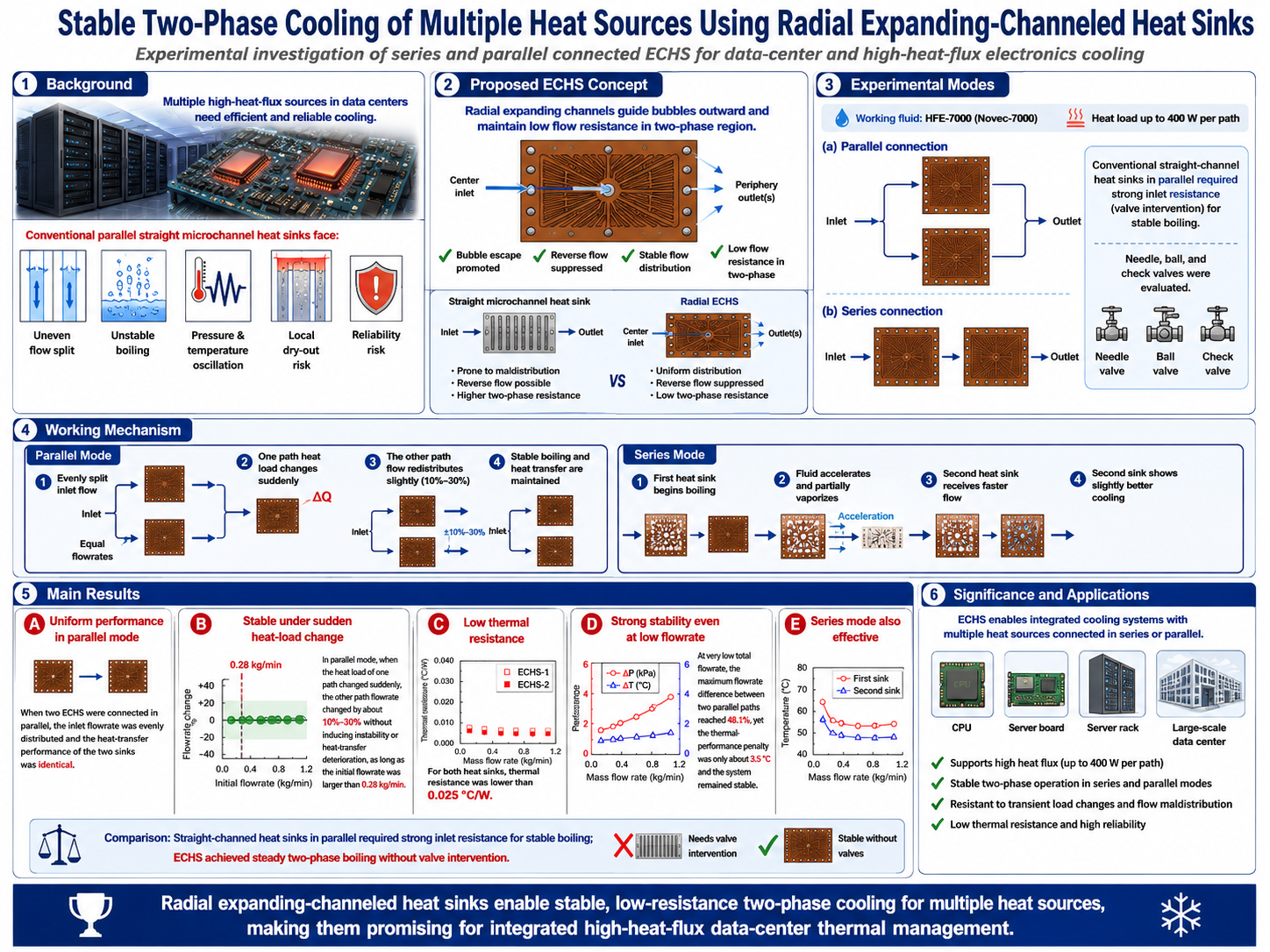
Figure: One-page graphical summary of the data-center multiple-heat-source cooling problem, radial expanding-channeled heat sink concept, parallel and series connection modes, two-phase flow stabilization mechanism, flow redistribution under sudden heat-load change, low thermal resistance, and potential applications.
Background and Objective
With the development of 5G, cloud computing, artificial intelligence, and big data, data centers are becoming larger and more power-dense. Cooling systems account for a large portion of data-center energy consumption, so efficient and reliable thermal management is essential.
In practical systems, multiple CPUs, server boards, and racks generate heat simultaneously, and the heat load of each source may vary suddenly. Conventional parallel microchannel boiling cooling can suffer from flow maldistribution, pressure fluctuation, temperature oscillation, reverse flow, and local dry-out, which threaten system reliability.
The objective of this study is to experimentally clarify whether radial expanding-channeled heat sinks can suppress two-phase flow instability and maintain stable cooling performance for multiple heat sources connected in parallel or series.
Key Features of This Study
- Radial expanding-channel structure: The working fluid enters from the center and flows outward through radially expanding channels to peripheral outlets.
- Low flow resistance and high stability: The expanding channels guide bubbles outward, suppress reverse flow, and maintain low pressure drop in the two-phase region.
- Multiple heat-source connection: Two ECHSs were connected in parallel and in series to represent practical multi-source cooling systems.
- Dynamic heat-load evaluation: The heat load of one path was suddenly changed while temperature, flowrate, and pressure responses of both paths were measured.
- Comparison with conventional straight channels: Conventional straight-channeled heat sinks were tested using needle, ball, and check valves for inlet-resistance stabilization.
Proposed Method and Working Mechanism
1. ECHS design concept
The working fluid enters the heat sink from a central inlet and flows radially toward peripheral outlets. The expanding channels match vapor generation and volume expansion during boiling, suppressing excessive vapor acceleration, reverse flow, and local dry-out.
2. Parallel-connection experiment
Two ECHSs were connected in parallel, and the heat load of one path was changed from 400 W to 0 W to evaluate flow redistribution, temperature response, and pressure difference under sudden load variation.
3. Series-connection experiment
Two ECHSs were connected in series, and the second heat sink received partially vaporized two-phase flow from the first heat sink. HTC, thermal resistance, and dry-out resistance were evaluated.
4. Comparison with straight-channeled heat sinks
For conventional straight-channeled heat sinks, inlet resistance was added using valves to stabilize two-phase flow. This comparison clarified whether ECHS can achieve stable operation without valve intervention.
Main Findings
Future Prospects
This study shows that radial expanding-channeled heat sinks can simultaneously achieve low pressure drop, strong two-phase flow stability, and low thermal resistance for electronics with multiple heat sources.
Future work should focus on long-term tests with real CPUs, GPUs, and server boards; larger parallel and series cooling networks; coolant selection; flow control; rack-level integrated thermal management; and reliability evaluation for data-center implementation.
Potential Applications
The proposed ECHS is suitable for electronic cooling systems with multiple high-heat-flux sources.
Summary
This study connected two radial expanding-channeled heat sinks and experimentally evaluated their flow boiling cooling performance in parallel and series modes.
ECHS achieved uniform flow distribution, low thermal resistance, tolerance to heat-load variation, and dry-out suppression without requiring strong inlet resistance from valves.
Paper Information and Links
Paper title:Experimental research on cooling performances of radial expanding-channeled heat sinks applied for multiple heat sources
Journal:Applied Thermal Engineering, 237 (2024) 121789
DOI:https://doi.org/10.1016/j.applthermaleng.2023.121789
Authors:Sihui Hong, Chengzhi Li, Chaobin Dang, Mengjie Song, Hitoshi Sakamoto