Research Overview
This study investigates the effect of lubricating oil on the flow boiling of the non-azeotropic ternary refrigerant R447A using entropy generation analysis. R447A is a potential substitute for R410A, and in practical vapor-compression refrigeration and heat-pump systems, lubricating oil from the compressor is inevitably entrained into the evaporator. Entropy generation models were established for R447A with and without oil to quantify the combined influence of heat transfer and pressure drop on overall irreversibility.
Graphical Abstract
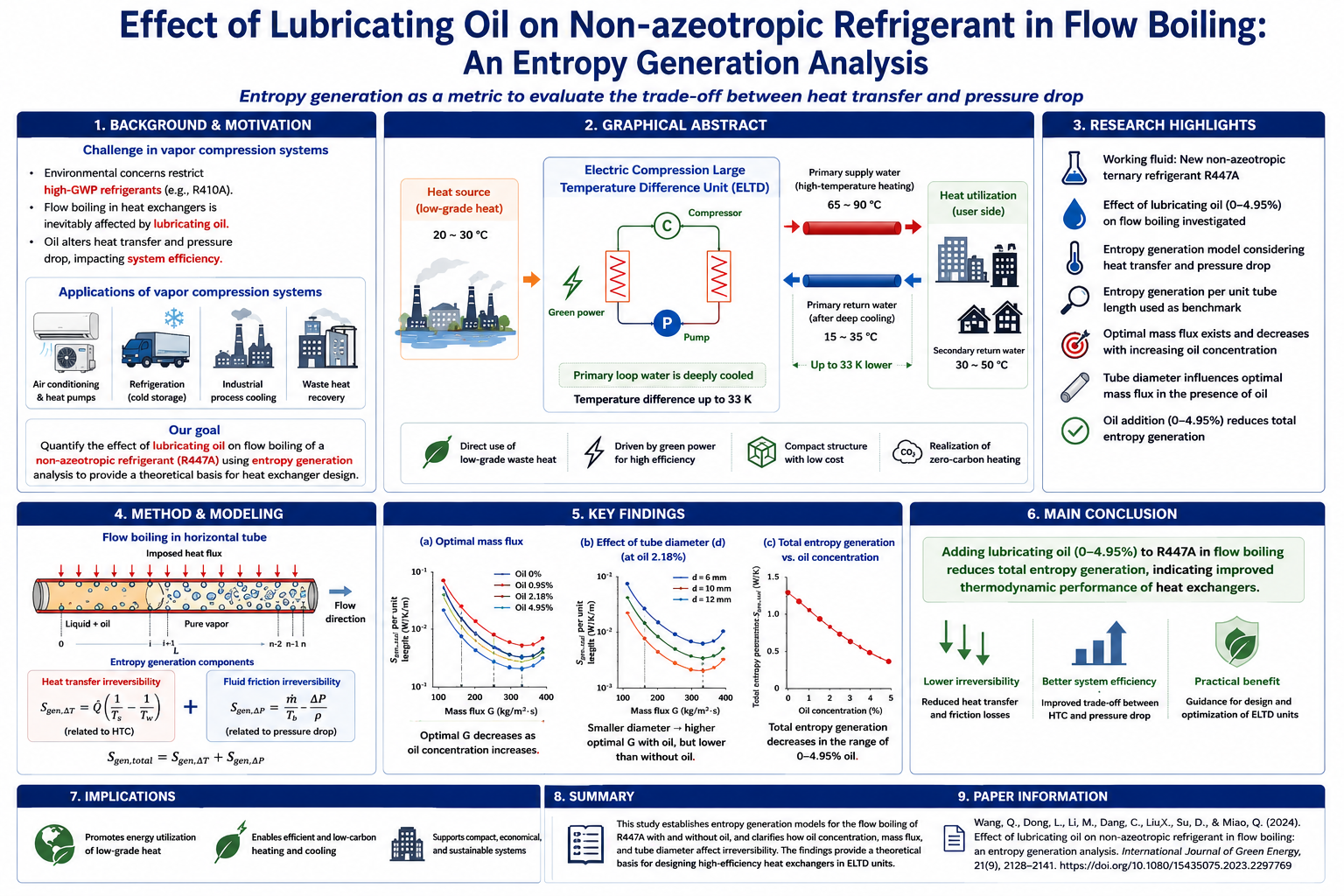
Figure: One-page graphical summary of the practical application background, R447A/oil flow boiling in a smooth horizontal tube, entropy generation components, parameter effects, and design implications for evaporators and heat exchangers.
Background and Objective
In refrigeration, air-conditioning, and heat-pump systems, the evaporator absorbs heat through refrigerant flow boiling. As the industry moves toward low-GWP refrigerants, non-azeotropic mixtures are attractive because their temperature glide can better match the heat-source temperature profile and improve energy efficiency.
In real vapor-compression systems, part of the compressor lubricating oil inevitably enters the evaporator with the refrigerant. This oil changes both the heat transfer coefficient and the pressure drop. Therefore, evaluating heat transfer alone or pressure drop alone is insufficient for heat exchanger design.
The objective of this study is to use entropy generation as an integrated thermodynamic metric to evaluate the trade-off between heat transfer and pressure drop in R447A/oil flow boiling and to identify favorable operating and geometric conditions for evaporator design.
Key Features of This Study
- Practical application background: The study focuses on oil entrainment from compressors into evaporators in vapor-compression systems.
- R447A as working fluid: A ternary non-azeotropic refrigerant mixture, R447A, was selected as a potential substitute for R410A.
- With-oil and without-oil comparison: Flow boiling entropy generation models were developed for both pure R447A and R447A/oil mixtures.
- Irreversibility decomposition: Total entropy generation was divided into heat-transfer entropy generation and pressure-drop entropy generation.
- Design benchmark: Entropy generation per unit tube length was used to eliminate the influence of different tube lengths under different operating conditions.
Proposed Method and Working Mechanism
1. Flow boiling model in a smooth horizontal tube
R447A or R447A/oil mixture was modeled in a single smooth horizontal tube under constant heat flux. The inlet vapor quality ranged from 0.2 to 0.6, and the outlet vapor quality was fixed at 1.0.
2. Entropy generation model
Total entropy generation was evaluated as the sum of heat-transfer irreversibility and pressure-drop irreversibility: Sgen,total = Sgen,h + Sgen,p. This allows thermal and hydraulic losses to be assessed in one framework.
3. Numerical calculation and parameter study
The tube was divided into many cells in MATLAB. Local pressure, local temperature, local oil concentration, local heat transfer coefficient, and local pressure drop were calculated. The effects of mass flux, heat flux, bubble point temperature, inlet vapor quality, tube diameter, and oil concentration were analyzed.
Main Findings
Future Prospects
This study provides a thermodynamic evaluation method for practical evaporators where non-azeotropic refrigerants and lubricating oil coexist. Future work can extend the analysis to other low-GWP refrigerants, different lubricating oils, enhanced tubes, microchannels, and real evaporator geometries.
Combining entropy generation analysis with experimental data and system-level performance evaluation can support the development of high-efficiency refrigeration, air-conditioning, and heat-pump systems with reduced refrigerant charge and lower environmental impact.
Potential Applications
The findings can be applied to evaporator and heat exchanger design for low-GWP refrigerants containing lubricating oil.
Summary
This study established entropy generation models for R447A and R447A/oil flow boiling and evaluated heat-transfer and pressure-drop irreversibilities in an integrated manner.
Lubricating oil increases pressure drop but can enhance heat transfer in low- and medium-quality regions. Within the investigated range, oil addition reduces total entropy generation.
Paper Information and Links
Paper title:Effect of lubricating oil on non-azeotropic refrigerant in flow boiling: an entropy generation analysis
Journal:International Journal of Green Energy, 21(9) (2024) 2128–2141
DOI:https://doi.org/10.1080/15435075.2023.2297769
Authors:Qifan Wang, Liwei Dong, Minxia Li, Chaobin Dang, Xuetao Liu, Dandan Su, Qing Miao