Research Overview
This study numerically investigates falling-film evaporation of R32/R134a non-azeotropic refrigerant outside a horizontal tube, focusing on flow characteristics and liquid film thickness distribution. A two-dimensional VOF model was established by incorporating multicomponent phase change and contact angle models into the governing equations. The effects of spray height, tube diameter, Reynolds number, inlet temperature, and R32 mass fraction in the liquid phase on local and average liquid film thickness were analyzed.
Graphical Abstract
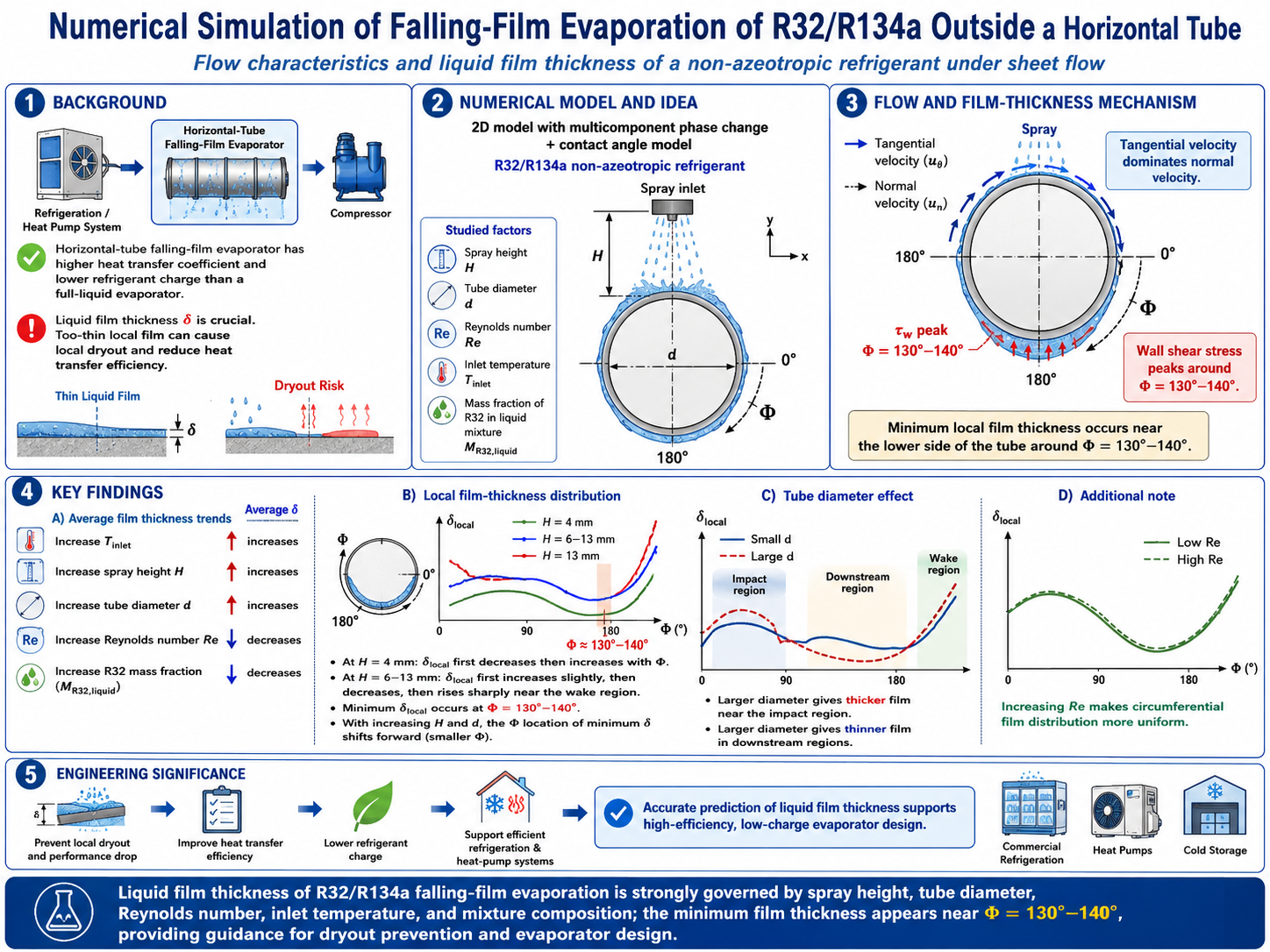
Figure: One-page graphical summary of a horizontal-tube falling-film evaporator, R32/R134a non-azeotropic refrigerant, two-dimensional VOF numerical model, multicomponent phase change, liquid film thickness distribution, tangential velocity, wall shear stress, minimum liquid-film-thickness location, and engineering significance for evaporator design.
Background and Objective
Horizontal-tube falling-film evaporators are regarded as effective alternatives to flooded evaporators because they can provide higher heat transfer coefficients and lower refrigerant charge.
In falling-film evaporation, liquid film thickness and its circumferential distribution strongly influence thermal resistance, flow stability, local dryout, and evaporator performance. Accurate prediction of local film thickness is essential for preventing heat transfer deterioration caused by dry patches.
For non-azeotropic refrigerants, temperature and concentration gradients appear during evaporation, and thermophysical properties vary nonlinearly with temperature and composition. Therefore, knowledge from water or pure refrigerants cannot fully describe R32/R134a film flow.
The objective of this study is to clarify the flow characteristics and film thickness distribution of R32/R134a falling-film evaporation outside a horizontal tube and to provide design guidance for high-efficiency, low-charge evaporators.
Key Features of This Study
- Non-azeotropic refrigerant FFE: R32/R134a mixture film flow outside a horizontal tube was investigated.
- Multicomponent phase-change model: Component diffusion, interfacial evaporation, latent heat, and thermophysical mixing rules were included.
- VOF interface tracking: The gas–liquid interface and liquid film thickness were tracked using the VOF model.
- Systematic parameter analysis: Spray height, tube diameter, Reynolds number, inlet temperature, and R32 mass fraction were compared.
- Minimum film-thickness location: The high-dryout-risk region was identified near Φ = 130°–140°.
Proposed Method and Working Mechanism
1. Two-dimensional numerical model
A 2D model was established for sheet-flow evaporation of R32/R134a film sprayed onto a horizontal tube. Liquid inlet, gas inlet, pressure outlet, symmetry boundaries, and no-slip tube wall were defined.
2. Thermophysical properties and mixing rules
Properties of R32 and R134a were obtained from REFPROP and fitted as functions of temperature. Mixture density, viscosity, thermal conductivity, specific heat, and surface tension were calculated using appropriate liquid- and gas-phase mixing rules.
3. Governing equations and phase change
The VOF model was used to track the gas–liquid interface. The SST k-ω turbulence model, CSF surface tension model, multicomponent mass transfer model, and latent heat model were coupled to simulate flow, heat transfer, and mass transfer.
4. Film thickness evaluation
Local liquid film thickness was calculated from the distance between the gas–liquid interface defined by VOF = 0.5 and the tube center. Average film thickness was obtained by integrating local film thickness along the circumferential direction.
Main Findings
Future Prospects
This study clarified the governing factors of film thickness distribution and the location of minimum film thickness during falling-film evaporation of R32/R134a outside a horizontal tube.
Future work should include direct experimental validation, three-dimensional tube-bundle models, liquid redistribution between adjacent tubes, practical refrigeration-cycle conditions, heat transfer models including dryout occurrence, and extension to other low-GWP refrigerant mixtures.
Potential Applications
The findings are useful for designing high-efficiency and low-charge evaporators.
Summary
This study numerically analyzed falling-film evaporation of R32/R134a non-azeotropic refrigerant outside a horizontal tube and evaluated film flow and liquid film thickness distribution.
Film thickness is strongly affected by spray height, tube diameter, Reynolds number, inlet temperature, and mixture composition. The minimum film thickness appears near Φ = 130°–140°, making liquid-film maintenance in this region essential for evaporator performance and dryout prevention.
Paper Information and Links
Paper title:Numerical simulation of flow characteristics of falling-film evaporation of R32/R134a non-azeotropic refrigerant outside a horizontal tube
Journal:Applied Thermal Engineering, 236 (2024) 121724
DOI:https://doi.org/10.1016/j.applthermaleng.2023.121724
Authors:Qifan Wang, Xuetao Liu, Minxia Li, Dandan Su, Chaobin Dang, Jie Peng, Beiran Hou, Liwei Dong