Research Overview
This study numerically investigates R134a flow boiling heat transfer in a horizontal circular mini-channel under zero gravity, lunar gravity, and normal gravity conditions for aerospace vapor compression refrigeration and heat pump systems. A three-dimensional VOF model was developed and validated to clarify the effects of gravity level on flow pattern, heat transfer coefficient (HTC), phase distribution, and a newly proposed gravity-independence criterion.
Graphical Abstract
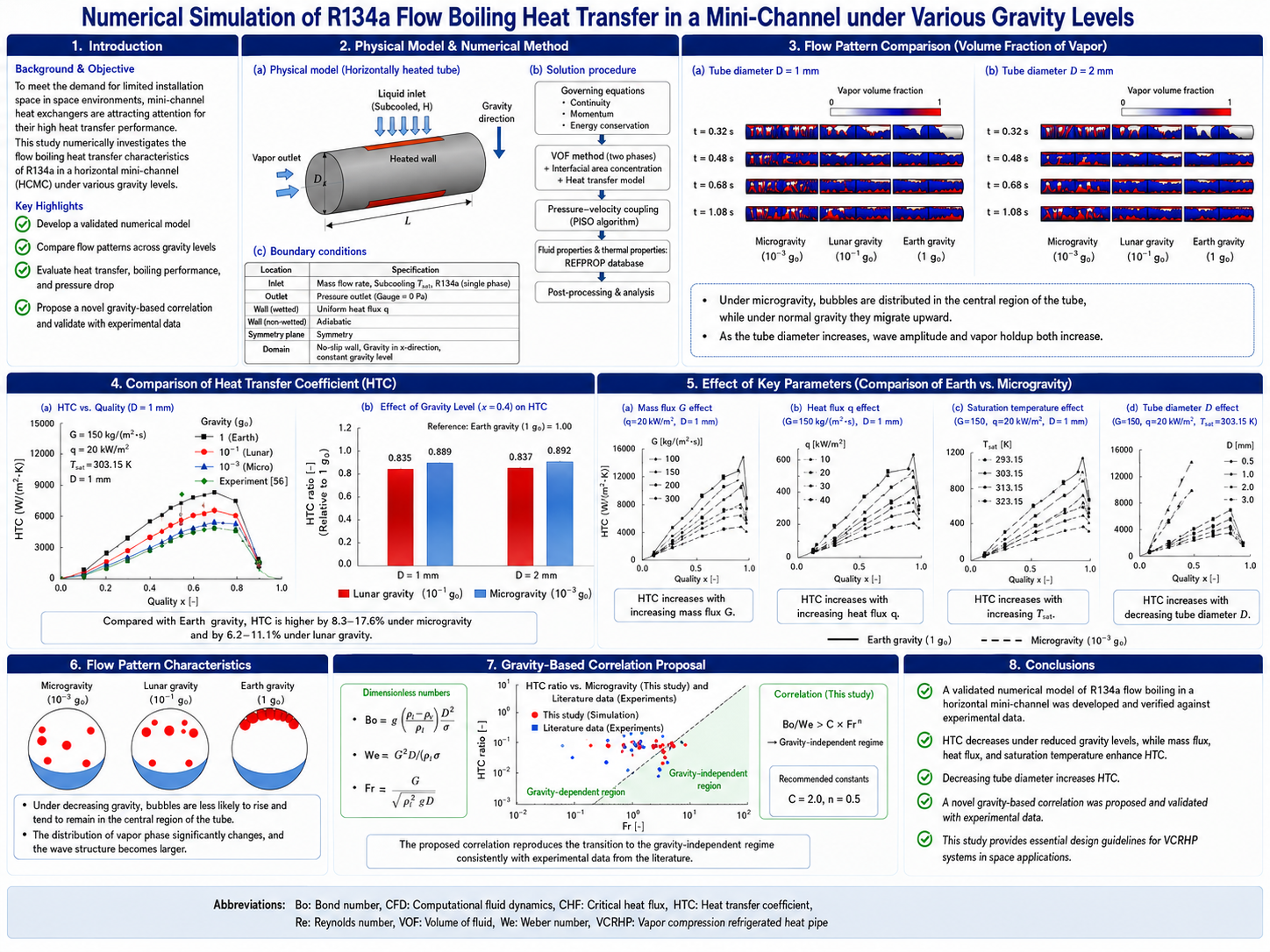
Figure: One-page graphical summary of aerospace VCRHP systems, horizontal circular mini-channel, R134a flow boiling, VOF model, flow pattern comparison under normal, lunar, and microgravity conditions, HTC variation, parametric effects, and the proposed gravity-independence criterion.
Background and Objective
Spacecraft require efficient thermal management under limited installation space and strict weight constraints. Vapor compression refrigeration and heat pump systems are promising for high-efficiency spacecraft thermal control.
Mini-channel heat exchangers are suitable for aerospace applications because they are compact, lightweight, have large surface-area-to-volume ratios, and can reduce refrigerant charge.
However, changing gravity levels alter gas-liquid distribution, bubble growth, bubble departure, flow pattern, liquid replenishment, and wall dryout, which strongly influence flow boiling heat transfer.
The objective of this study is to clarify the effect of gravity level on R134a flow boiling in a horizontal mini-channel and to provide guidance for aerospace mini-channel evaporator and heat exchanger design.
Key Features of This Study
- Aerospace VCRHP target: The study focuses on horizontal mini-channel evaporators for spacecraft vapor compression refrigeration and heat pump systems.
- Three gravity conditions: Zero gravity, lunar gravity, and normal gravity were compared.
- Three-dimensional VOF model: Gas-liquid interfaces, bubble growth, and flow pattern transitions of R134a were tracked.
- Systematic parameter analysis: The effects of mass flux, heat flux, saturation temperature, and tube diameter on HTC were evaluated.
- Gravity-independence criterion: A new discriminant was proposed to identify conditions where gravity influence on HTC can be neglected.
Proposed Method and Working Mechanism
1. Horizontal circular mini-channel model
A 260 mm horizontal circular mini-channel was modeled. The front and rear 30 mm sections were adiabatic, while the middle 200 mm section was heated with constant wall heat flux. Saturated liquid R134a entered the channel, and a pressure outlet was used.
2. Properties and phase-change model
Thermophysical properties of R134a were obtained from REFPROP and fitted as functions of temperature. The VOF model, CSF surface tension model, SST k-ω turbulence model, and Lee phase-change model were used to simulate two-phase flow and evaporation.
3. Gravity conditions and parameters
Zero gravity, lunar gravity, and normal gravity were applied. The effects of mass flux, heat flux, saturation temperature, and tube diameter on HTC and flow patterns were analyzed.
4. Gravity-independence judgment
Gravity influence was considered negligible when the ratio of microgravity HTC to normal-gravity HTC was at least 0.9. A new criterion based on Bo, WeG, and ReG was established.
Main Findings
Future Prospects
This study quantitatively clarifies the effect of gravity level on flow boiling heat transfer in horizontal mini-channel evaporators for aerospace VCRHP systems.
Future work should include further experimental validation, system-level integration for spacecraft thermal management, extension to other refrigerants, channel shapes, and heat loads, and analysis of long-term instability and dryout.
Potential Applications
The findings are useful for compact, lightweight, and high-efficiency two-phase thermal management systems in space environments.
Summary
This study numerically analyzed R134a flow boiling in a horizontal mini-channel and compared flow patterns and HTC under zero gravity, lunar gravity, and normal gravity.
Reduced gravity decreases HTC, but its effect can be weakened by increasing mass flux, decreasing heat flux, increasing saturation temperature, and reducing tube diameter.
Paper Information and Links
Paper title:Numerical simulation of R134a flow boiling heat transfer in a horizontal mini-channel under various gravity levels
Journal:International Journal of Heat and Mass Transfer, 235 (2024) 126141
DOI:https://doi.org/10.1016/j.ijheatmasstransfer.2024.126141
Authors:Qifan Wang, Jianfeng Cao, Dandan Su, Minxia Li, Chaobin Dang, Xuetao Liu, Ruitao Song, Jing Li