Research Overview
This study proposes a single-ejector cascade heat pump system (SECHPS) and a double-ejector cascade heat pump system (DECHPS) to improve the performance of cascade air source heat pumps under low ambient temperature and high-temperature hot-water conditions. Nine refrigerant pairs were compared, and R1234yf/R245fa was selected based on COP, safety, and environmental characteristics. Thermodynamic, economic, and environmental models were then used to evaluate COP, pressure ratio, compressor power consumption, annual electricity consumption, operating cost, and TEWI.
Graphical Abstract
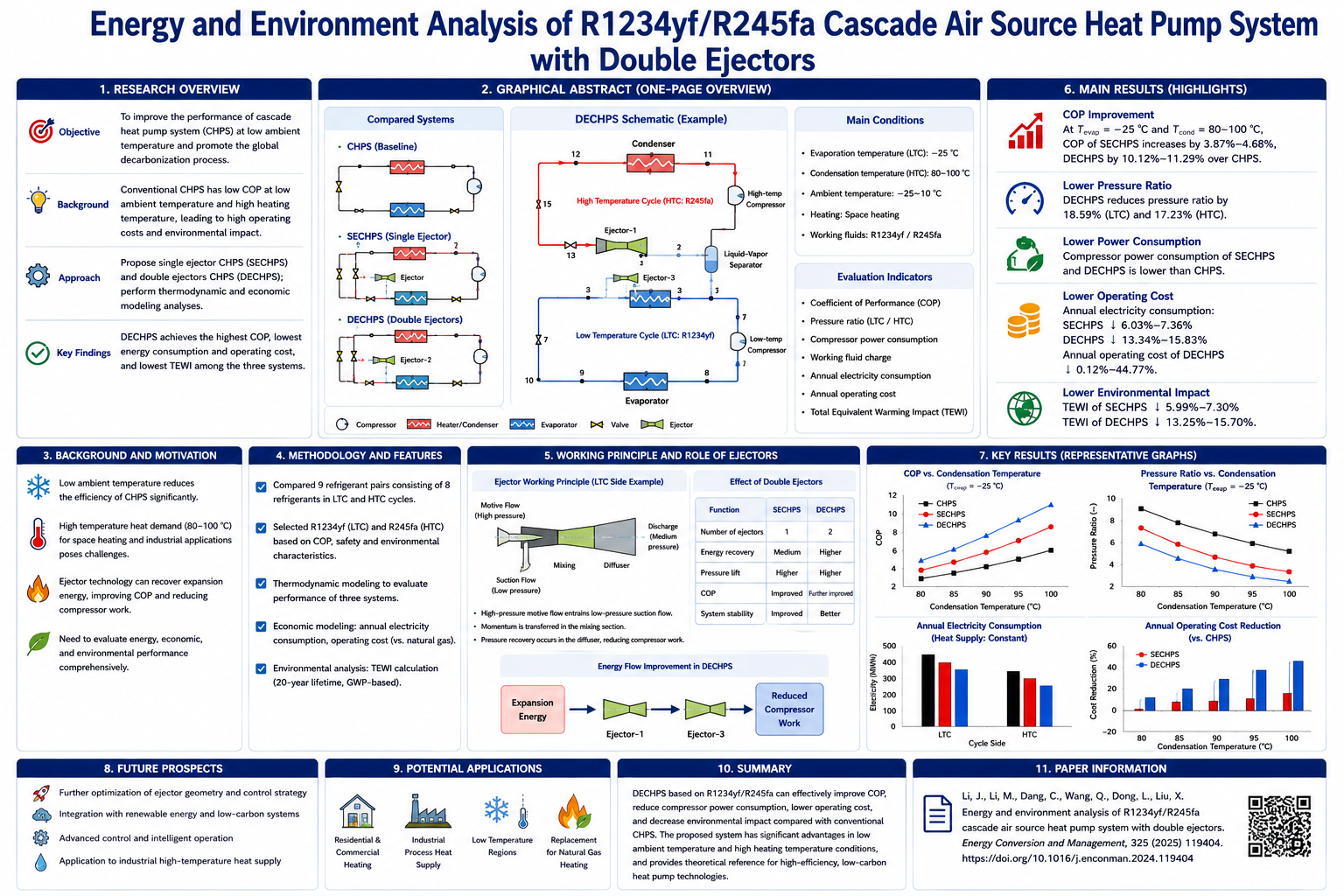
Figure: One-page graphical summary comparing CHPS, SECHPS, and DECHPS, highlighting the R1234yf/R245fa refrigerant pair, expansion work recovery by double ejectors, COP improvement, pressure-ratio reduction, lower annual electricity consumption, lower operating cost, and reduced TEWI.
Background and Objective
Decarbonization of heating and hot-water supply is important for achieving carbon peaking and carbon neutrality. Air source heat pumps offer energy-saving and environmental benefits, but conventional single-stage systems face high pressure ratio, high discharge temperature, and low COP when producing 80–100 °C hot water under low ambient temperature.
Cascade heat pump systems can meet large temperature-lift requirements by coupling a low-temperature cycle and a high-temperature cycle. However, conventional CHPS still suffers from irreversible losses during throttling, limiting efficiency improvement.
The objective of this study is to introduce ejectors into CHPS to recover expansion work, increase compressor suction pressure, reduce compressor work, and evaluate the energy, economic, and environmental benefits of SECHPS and DECHPS compared with conventional CHPS.
Key Features of This Study
- Two improved systems proposed: SECHPS and DECHPS are developed based on conventional CHPS.
- Double-ejector enhancement: DECHPS introduces ejectors into both the low-temperature and high-temperature cycles to recover expansion work.
- Refrigerant-pair selection: Nine refrigerant pairs were compared, and R1234yf/R245fa was selected for further analysis.
- Energy–economic–environmental evaluation: COP, pressure ratio, compressor power consumption, annual electricity consumption, annual operating cost, and TEWI were evaluated.
- Regional applicability: Five Chinese cities, Harbin, Tianjin, Wuhan, Guangzhou, and Kunming, were analyzed considering climate and energy-price differences.
Proposed Method and Working Mechanism
1. Comparison of CHPS, SECHPS, and DECHPS
The conventional cascade heat pump system is used as the baseline. SECHPS adds an ejector in the low-temperature cycle, while DECHPS adds ejectors in both the low-temperature and high-temperature cycles.
2. Expansion work recovery by ejectors
The ejector uses high-pressure motive flow to entrain low-pressure suction flow, mix the two streams, and recover pressure. This increases compressor suction pressure and reduces compressor work and pressure ratio.
3. Refrigerant selection and thermodynamic modeling
Candidate refrigerants were screened for the low- and high-temperature cycles. Considering COP, ODP, GWP, and safety, R1234yf/R245fa was selected. MATLAB and REFPROP were used for cycle simulation.
4. Economic and environmental analysis
Annual electricity consumption and operating cost were compared with natural-gas heating. TEWI was calculated to quantify the total equivalent warming impact from refrigerant leakage and electricity consumption.
Main Findings
Future Prospects
This study shows that combining cascade heat pump architecture with ejector cycles is effective for improving COP, reducing compressor load, lowering operating cost, and reducing environmental impact under low ambient temperature and high-temperature hot-water conditions.
Future work should focus on ejector geometry optimization, part-load operation, dynamic control, defrosting operation, experimental validation, additional low-GWP refrigerant pairs, and integration with AI-based control to promote practical applications in cold regions and high-temperature heating systems.
Potential Applications
The proposed systems can be applied to heating and hot-water systems requiring large temperature lift under low ambient temperature.
Summary
This study proposed SECHPS and DECHPS by introducing ejectors into an R1234yf/R245fa cascade air source heat pump system.
DECHPS achieved the best performance among the three systems, showing the highest COP, lowest compressor power consumption, lowest annual electricity consumption, and lowest TEWI.
Paper Information and Links
Paper title:Energy and environment analysis of R1234yf/R245fa cascade air source heat pump system with double ejectors
Journal:Energy Conversion and Management, 325 (2025) 119404
DOI:https://doi.org/10.1016/j.enconman.2024.119404
Authors:Jing Li, Minxia Li, Chaobin Dang, Qifan Wang, Liwei Dong, Xuetao Liu