Research Overview
This study develops a new spring-mass-damper model based on a separated phase flow mode to describe the oscillating behavior of vapor–liquid slug flow in pulsating heat pipes (PHPs). Conventional models often approximate the frictional resistance of two-phase flow as single-phase flow, which cannot adequately reflect the real pressure loss of slug flow. By incorporating separated two-phase pressure loss and liquid-film evaporation, this study evaluates the thermal performance of a newly proposed pulsating heat pipe with adjustive-structured channels (ASCPHP).
Graphical Abstract
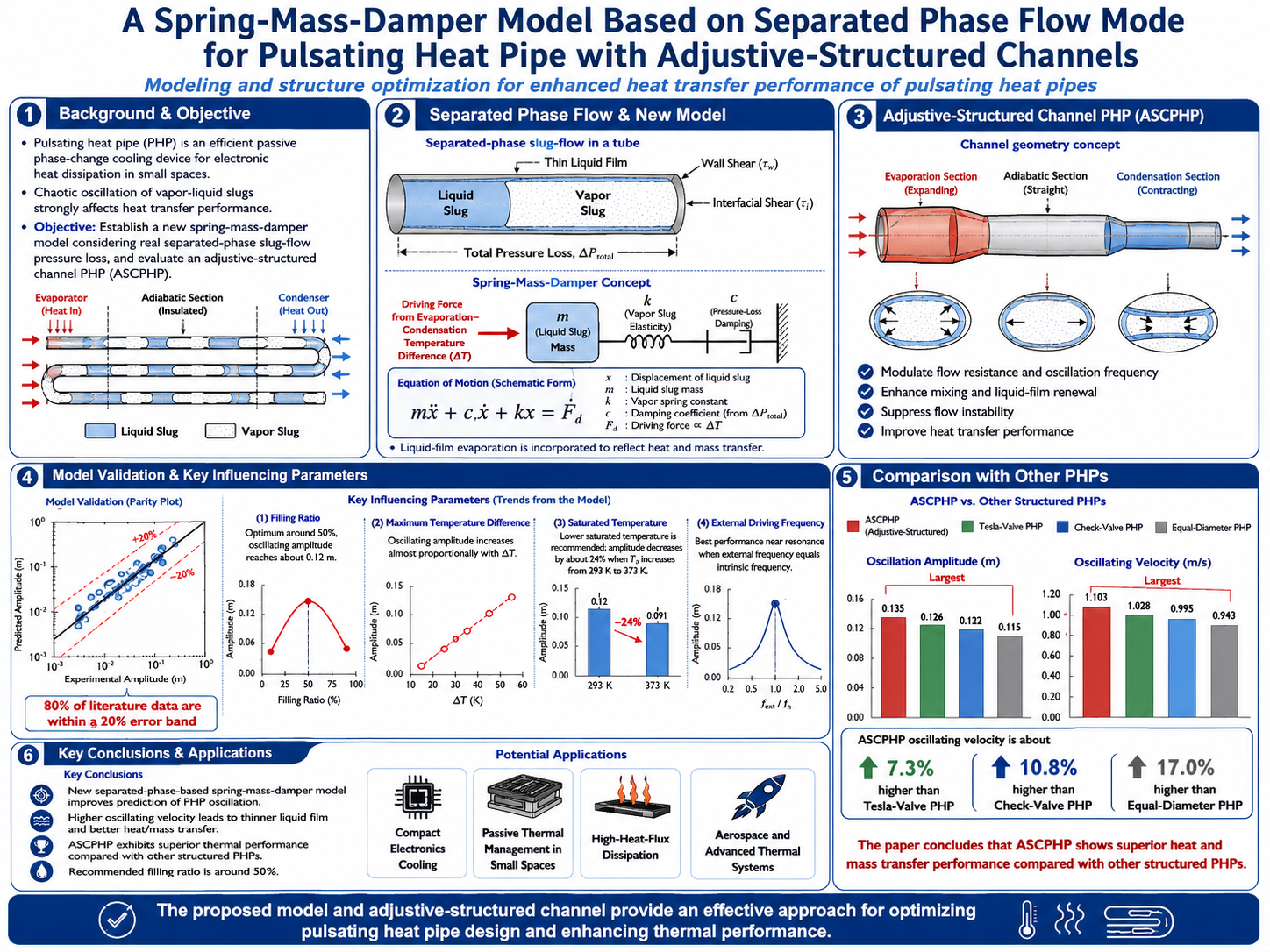
Figure: One-page summary of the background, spring-mass-damper model, adjustive-structured channel PHP, model validation, main results, and potential applications.
Background and Objective
Pulsating heat pipes (PHPs) are compact and efficient passive phase-change cooling devices. Inside a PHP, vapor slugs and liquid slugs are alternately formed and oscillate due to the pressure difference between the evaporating and condensing sections, thereby transporting heat.
However, the vapor–liquid two-phase flow inside a PHP is highly complex and often chaotic, making performance prediction and structural optimization difficult. This study aims to establish a more realistic model based on separated phase flow and to evaluate the heat transfer enhancement potential of adjustive-structured channels.
Key Features of This Study
- Separated phase flow model: Realistic two-phase pressure loss of slug flow is introduced into the damping term.
- Spring-mass-damper model: Liquid slugs are represented as masses, vapor slugs as springs, and frictional resistance as dampers.
- Liquid-film evaporation model: Film thickness, evaporation mass, and heat transfer coefficient are related to oscillation behavior.
- ASCPHP structure: An expanding evaporator section and contracting condenser section are proposed to improve thermal performance.
Proposed Method and Working Mechanism
1. Dynamic modeling of vapor–liquid slugs
Adjacent liquid slugs are treated as masses, while the vapor slug between them is treated as a spring. The pressure difference caused by the temperature difference between the evaporator and condenser drives the reciprocating motion.
2. Pressure loss evaluation with separated phase flow
Instead of using a single-phase approximation, the proposed model evaluates frictional pressure loss based on the separated two-phase flow model, which better represents real slug flow in PHPs.
3. Heat transfer enhancement by adjustive-structured channels
The evaporator section expands to promote vapor discharge and liquid-film evaporation, while the condenser section contracts to enhance condensation heat transfer. This structure promotes more stable and directional oscillation.
Main Findings
Future Prospects
The proposed separated-phase-flow-based spring-mass-damper model can more realistically reflect vapor–liquid slug flow in pulsating heat pipes. Therefore, it is useful for predicting oscillation characteristics and optimizing PHP channel structures.
Future work can extend the model to different working fluids, filling ratios, orientations, heat-load conditions, and channel geometries. Further comparison with experimental results will help establish more practical design guidelines for adjustive-structured channel PHPs.
This approach is particularly promising for compact systems where high heat transport performance must be achieved within a limited space, such as electronics cooling and advanced thermal management systems.
Potential Applications
The results can support the design of compact and high-performance passive cooling devices.
Summary
This study proposed a separated-phase-flow-based spring-mass-damper model to evaluate vapor–liquid slug oscillation in pulsating heat pipes more realistically.
The ASCPHP concept showed higher oscillating velocity and promising heat transfer enhancement compared with other structured PHPs.
Paper Information and Links
Paper title:A spring-mass-damper model based on separated phase flow mode for pulsating heat pipe with adjustive-structured channels
Journal:Applied Thermal Engineering, 257 (2024) 124275
DOI:https://doi.org/10.1016/j.applthermaleng.2024.124275
Authors:Sihui Hong, Jiangchuan Yu, Chaobin Dang