Research Overview
This study experimentally investigates nucleate boiling heat transfer of non-azeotropic refrigerants on micro-nano composite structured surfaces. First, the boiling performances of R32, R1234yf, R454B, R454C, and R32/R1234yf mixture were tested on a smooth surface. Then, R32 and R454B were selected to evaluate composite surfaces fabricated by mechanical machining, femtosecond laser processing, oxidation etching, and low-surface-energy modification.
Graphical Abstract
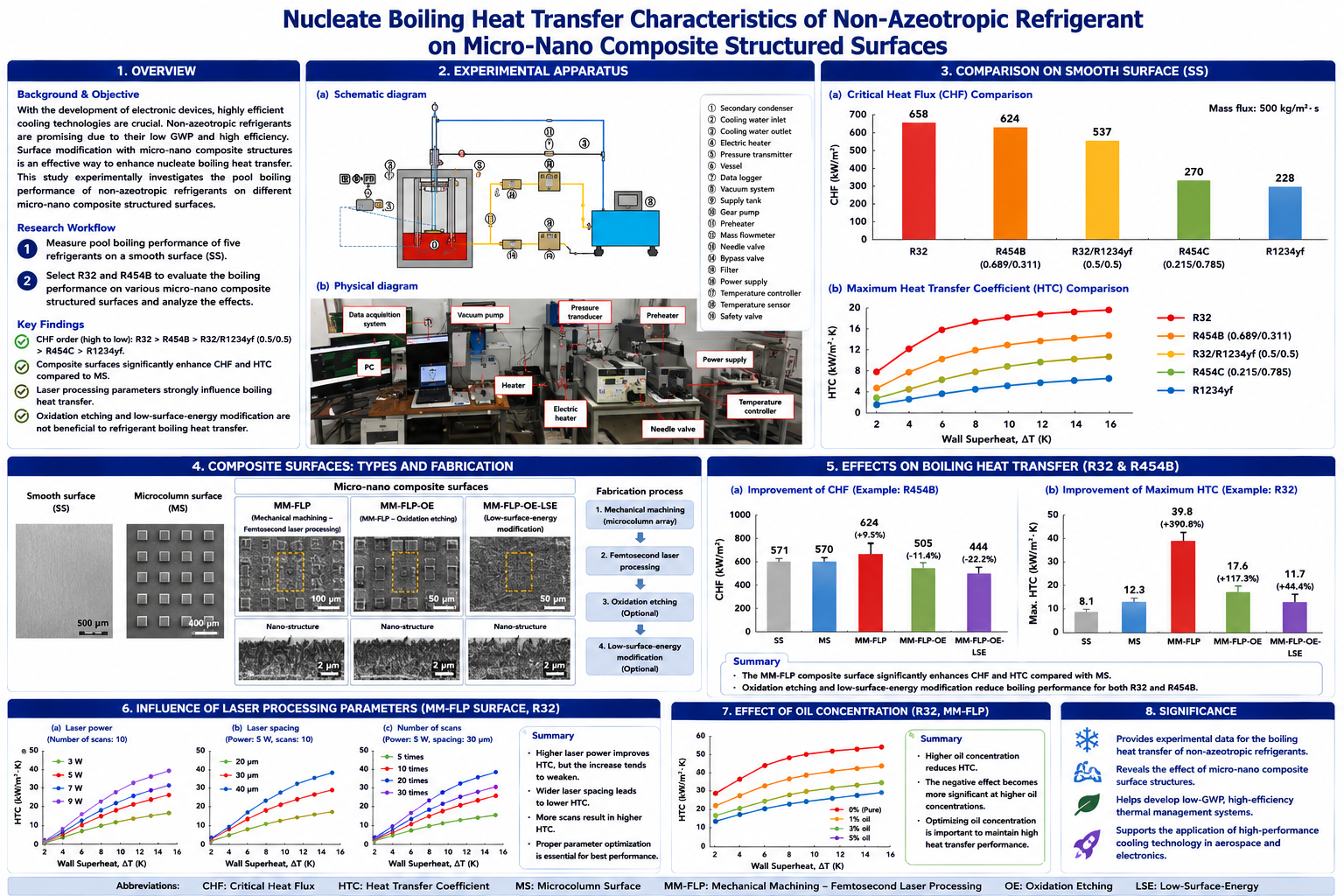
Figure: One-page graphical summary of electronic thermal management, non-azeotropic refrigerants, high-pressure pool boiling experiment, refrigerant comparison on smooth surface, micro-nano composite surface fabrication, laser-processing parameters, CHF and HTC enhancement, and the effects of oxidation etching and low-surface-energy treatment.
Background and Objective
High integration of electronic devices imposes increasing demands on thermal management systems. Under high heat flux, single-phase cooling becomes insufficient, while boiling phase-change cooling is promising because it uses latent heat.
Working-fluid selection must balance environmental protection, safety, and energy efficiency. R32 has good heat transfer performance but higher GWP and mild flammability, while R1234yf is environmentally friendly but has weaker heat transfer performance.
Non-azeotropic R32/R1234yf mixtures can balance environmental and thermal performance by adjusting composition. However, because temperature glide and concentration-difference-induced mass transfer resistance exist, findings from water or pure fluids cannot be directly applied.
The objective of this study is to clarify how micro-nano composite structured surfaces affect nucleate boiling heat transfer of non-azeotropic refrigerants and to provide surface-design guidance for high-heat-flux cooling.
Key Features of This Study
- Non-azeotropic refrigerants: R32/R1234yf-based mixtures were evaluated for low-GWP boiling heat transfer.
- High-pressure pool boiling apparatus: A sealed high-pressure experimental system was developed to maintain low-boiling-point refrigerants in the liquid phase.
- Composite surface fabrication: Microcolumn surfaces were combined with mechanical machining, femtosecond laser processing, oxidation etching, and low-surface-energy modification.
- CHF and HTC evaluation: Critical heat flux and heat transfer coefficient were compared for different refrigerants and surfaces.
- Different behavior from water: Nanowire structures and low-surface-energy modification can be detrimental for refrigerant boiling, unlike many results for water.
Proposed Method and Working Mechanism
1. Refrigerant comparison
Pool boiling experiments were conducted on a smooth surface using R32, R1234yf, R454B, R454C, and R32/R1234yf = 0.5/0.5 to evaluate the influence of refrigerant composition on CHF and HTC.
2. Composite surface preparation
A microcolumn surface was fabricated on copper by mechanical machining. Femtosecond laser processing was then applied to create the MM-FLP composite surface. Oxidation etching added nanowire structures, and low-surface-energy modification was optionally applied.
3. Laser-processing parameters
Laser power, laser scan spacing, and number of laser scans were varied to investigate how surface roughness, nucleation-site density, capillary action, and bubble departure affect boiling performance.
4. Bubble behavior and mechanism
High-speed imaging was used to observe bubble nucleation, growth, coalescence, and departure. The microcolumns and laser-induced mound structures disturb the thermal boundary layer, enhance liquid replenishment, and suppress large-bubble coalescence.
Main Findings
Future Prospects
This study shows that micro-nano composite surfaces can effectively enhance nucleate boiling heat transfer of non-azeotropic refrigerants, while nanowire structures and low-surface-energy treatments that are often beneficial for water may not be suitable for refrigerants.
Future work should examine more low-GWP non-azeotropic refrigerants, practical flow boiling conditions, long-term durability, surface contamination, optimization of refrigerant-specific wettability and capillary action, and implementation in electronic cooling systems.
Potential Applications
The findings are useful for designing enhanced boiling surfaces for low-GWP refrigerant-based high-heat-flux cooling systems.
Summary
This study experimentally evaluated nucleate boiling heat transfer of non-azeotropic refrigerants on smooth and micro-nano composite structured surfaces.
MM-FLP composite surfaces enhanced CHF and HTC by increasing nucleation-site density, capillary pumping, bubble departure, and thermal-boundary-layer disturbance. Oxidation etching and low-surface-energy modification should be applied carefully because they can hinder liquid supply for refrigerants.
Paper Information and Links
Paper title:Nucleate boiling heat transfer characteristics of non-azeotropic refrigerant on micro-nano composite structured surfaces
Journal:Applied Thermal Engineering, 267 (2025) 125823
DOI:https://doi.org/10.1016/j.applthermaleng.2025.125823
Authors:Qifan Wang, Dandan Su, Jing Li, Minxia Li, Chaobin Dang, Chengjuan Yang, Chenxu Wang