Research Overview
This paper is a systematic review and meta-analysis on the effects of lubricating oil on flow and heat transfer characteristics in microchannel heat exchangers used in vapor compression refrigeration and heat pump systems. It summarizes research from the past two decades and clarifies how oil affects oil retention, refrigerant distribution, flow behavior, heat transfer, and pressure drop in microchannel evaporators, condensers, and gas coolers.
Graphical Abstract
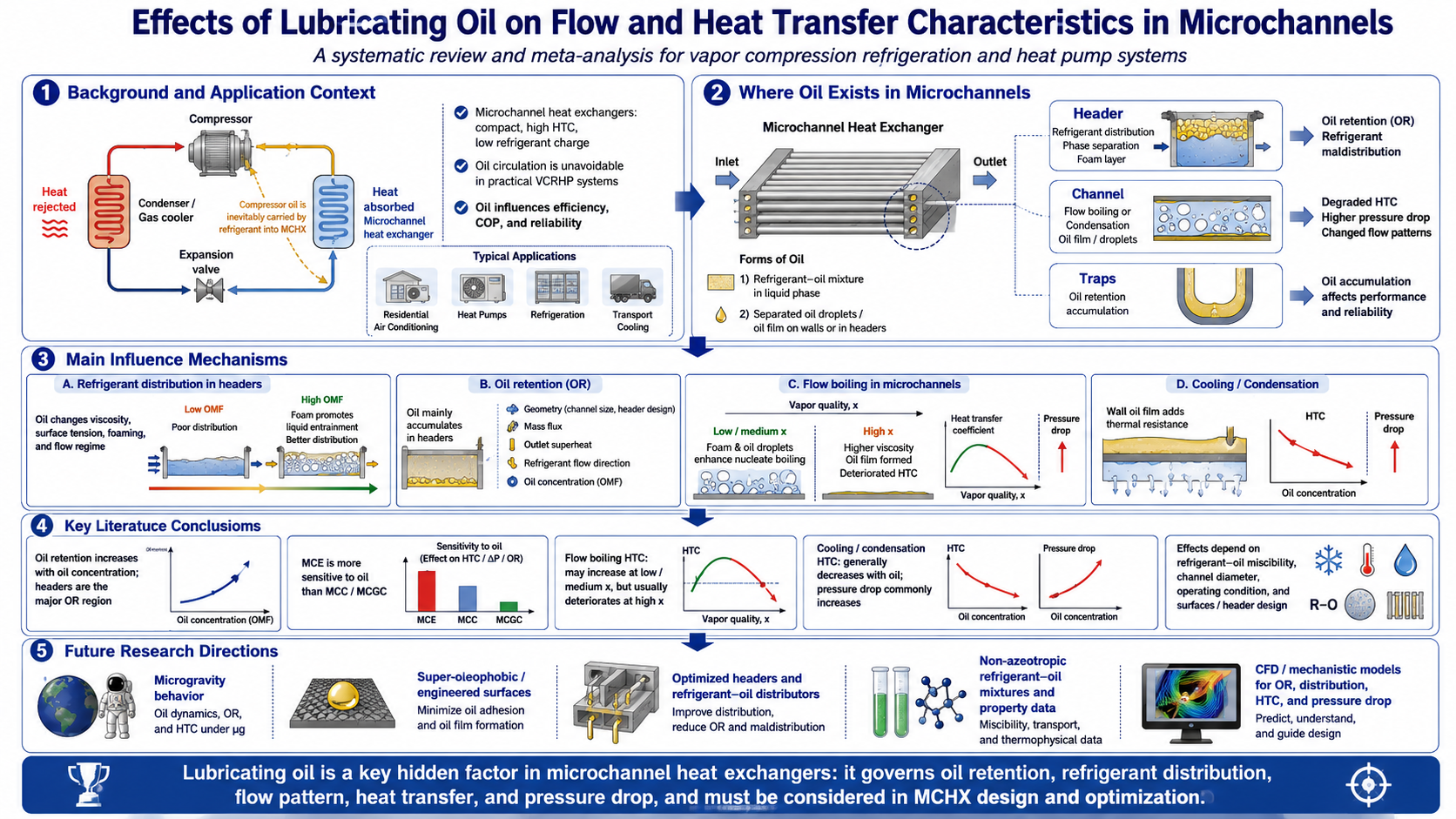
Figure: One-page graphical summary of oil circulation in vapor compression systems, oil retention and refrigerant maldistribution in microchannel heat exchangers, effects on flow boiling and cooling/condensation, key literature conclusions, and future research directions.
Background and Objective
Vapor compression refrigeration and heat pump systems are widely used in residential air conditioning, refrigeration, heat pumps, cold-chain transportation, food processing, pharmaceutical storage, and transport cooling. Because these systems consume large amounts of energy, improving heat exchanger performance is essential for higher COP and lower carbon emissions.
Microchannel heat exchangers offer compact structure, high heat transfer coefficient, high pressure capacity, and low refrigerant charge. However, they also face challenges such as refrigerant maldistribution, oil retention, flow-pattern transition, and pressure-drop increase. In practical systems, lubricating oil from the compressor is inevitably carried into the heat exchanger by the refrigerant.
The objective of this review is to systematically clarify how lubricating oil affects refrigerant distribution, oil retention, flow boiling, cooling/condensation, heat transfer coefficient, and pressure drop in microchannels, and to identify future research directions for MCHX design and optimization.
Key Features of This Study
- Systematic review: The study summarizes research from the past two decades on lubricating-oil effects in microchannel heat exchangers.
- Integrated phenomena: Oil retention, refrigerant distribution, flow behavior, flow boiling, cooling/condensation, heat transfer, and pressure drop are discussed together.
- Practical component view: The review considers evaporators, condensers, gas coolers, headers, channels, and oil-trap regions in practical VCRHP systems.
- Mechanism classification: Oil film, oil droplets, refrigerant–oil mixture, foam layer, viscosity, surface tension, and wettability are identified as key mechanisms.
- Future research map: The paper proposes future directions including microgravity, super-oleophobic surfaces, optimized headers, non-azeotropic refrigerant–oil mixtures, and CFD/mechanistic modeling.
Proposed Method and Working Mechanism
1. Organization of reviewed studies
Experimental, numerical, and modeling studies on refrigerant–oil mixtures were reviewed and categorized into four core phenomena: refrigerant distribution, oil retention, flow boiling, and cooling/condensation.
2. Forms of oil in microchannels
Lubricating oil can exist as a refrigerant–oil mixture in the liquid phase, as separated oil droplets, as wall oil films, as foam layers in headers, or as accumulated oil in trap regions. These forms determine how oil affects performance.
3. Extraction of influence mechanisms
Oil modifies viscosity, surface tension, wettability, foaming, local oil concentration, and flow pattern. These changes affect refrigerant maldistribution, oil retention, heat transfer coefficient, and pressure drop.
4. Identification of research gaps
The paper identifies future needs in property measurement, surface engineering, header optimization, refrigerant–oil distribution modeling, and CFD-based prediction of oil retention, heat transfer, and pressure drop.
Main Findings
Future Prospects
This review shows that lubricating oil is not merely a heat-transfer deterioration factor, but a coupled factor affecting oil retention, refrigerant distribution, flow pattern, pressure drop, heat transfer, and system reliability.
Future work should focus on oil behavior under microgravity, super-oleophobic and functional surfaces for suppressing oil adhesion, optimized header and refrigerant–oil distributor design, thermophysical property measurement of non-azeotropic refrigerant–oil mixtures, and CFD/mechanistic models for predicting oil retention, heat transfer, and pressure drop.
These directions are important for designing high-efficiency microchannel heat exchangers with low refrigerant charge, supporting low-GWP refrigerant transition, and improving COP in refrigeration and heat pump systems.
Potential Applications
The findings are useful for the design and evaluation of microchannel heat exchangers operating with oil-bearing refrigerants.
Summary
This review systematically summarizes the effects of lubricating oil on oil retention, refrigerant distribution, flow boiling, cooling/condensation, heat transfer, and pressure drop in microchannel heat exchangers.
Lubricating oil acts as a hidden governing factor in microchannel heat exchangers and strongly affects system efficiency, COP, reliability, refrigerant distribution, and pressure loss.
Paper Information and Links
Paper title:Effects of lubricating oil on flow and heat transfer characteristics in microchannel: A systematic review and meta-analysis
Journal:International Journal of Heat and Mass Transfer, 235 (2024) 126199
DOI:https://doi.org/10.1016/j.ijheatmasstransfer.2024.126199
Authors:Qifan Wang, Dandan Su, Minxia Li, Zhipeng Wang, Chaobin Dang, Xuetao Liu, Jing Li, Pai Wang