Research Overview
This study experimentally investigates frosting characteristics and performance degradation of microchannel evaporators with different aspect ratios. Infrared thermal imaging and digital image processing were used to quantify refrigerant distribution, while frost height, frost coverage area, frost weight, air-side hydraulic resistance, evaporation pressure, refrigerant pressure loss, and heat transfer rate were analyzed under frosting conditions.
Graphical Abstract
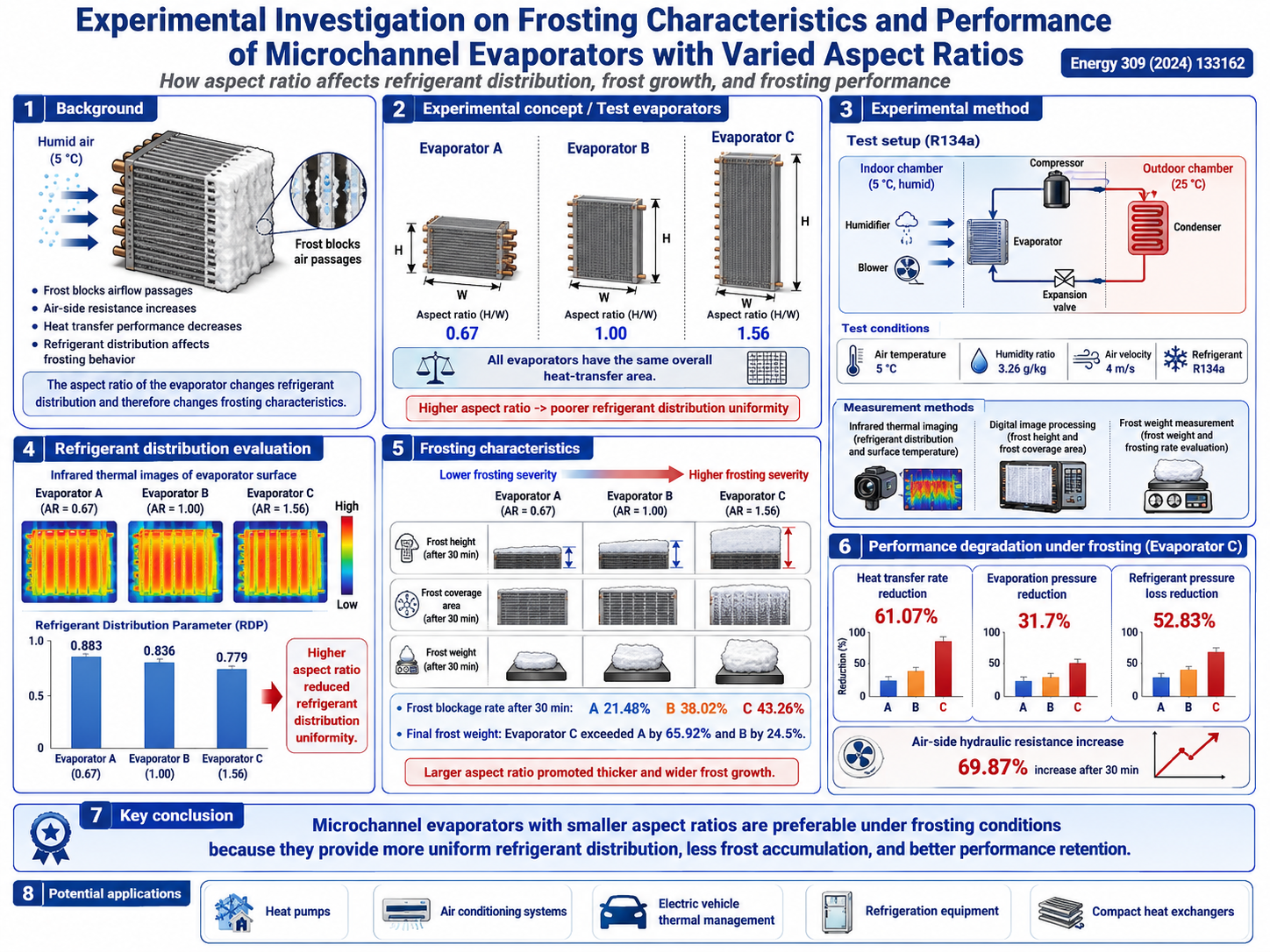
Figure: One-page summary of the research background, three test evaporators, experimental method, refrigerant distribution evaluation, frosting characteristics, performance degradation, and potential applications.
Background and Objective
Microchannel evaporators are widely used in refrigeration, air conditioning, heat pumps, and transportation systems because of their compactness and high efficiency. However, under low-temperature and humid conditions, frost forms on evaporator fins, blocks air passages, increases air-side resistance and thermal resistance, and significantly degrades heat transfer performance.
The structure of a microchannel evaporator, especially its aspect ratio, affects internal refrigerant distribution. This changes the surface temperature distribution and therefore influences frost growth. This study aims to clarify how evaporator aspect ratio affects refrigerant distribution, frosting behavior, and performance under frosting conditions.
Key Features of This Study
- Three aspect ratios: Microchannel evaporators with aspect ratios of 0.67, 1.00, and 1.56 were compared.
- Quantitative refrigerant distribution: Infrared thermography and image processing were used to identify two-phase and superheated regions.
- Frost growth analysis: Frost height, frost coverage area, frost weight, and blockage rate were quantified.
- Performance evaluation: Heat transfer rate, evaporation pressure, refrigerant pressure loss, and air-side pressure loss were measured.
- Design guidance: The study provides practical guidance for selecting evaporator aspect ratio under frosting conditions.
Proposed Method and Working Mechanism
1. Comparison of evaporators with different aspect ratios
Three evaporators with the same overall heat transfer area were tested. Their aspect ratios were 0.67, 1.00, and 1.56, allowing the influence of geometry on refrigerant distribution and frost growth to be compared.
2. Refrigerant distribution evaluation by infrared thermography
Infrared images of evaporator surface temperature were used to distinguish the two-phase region from the superheated region. Refrigerant distribution uniformity was quantified using the Refrigerant Distribution Parameter (RDP).
3. Frost layer evaluation by image processing
Frost images were binarized to calculate frost height, frost coverage area, and frost blockage rate. Frost weight and frosting rate were evaluated from the inlet and outlet states of humid air.
4. Performance degradation analysis
Heat transfer rate, evaporation pressure, refrigerant pressure loss, and air-side pressure loss were measured over the frosting period to evaluate the effect of aspect ratio on performance degradation.
Main Findings
Future Prospects
This study shows that the aspect ratio of microchannel evaporators strongly affects refrigerant distribution, frost accumulation, air-side resistance, and heat transfer performance. Future designs should optimize not only aspect ratio but also header structure, flat-tube arrangement, fin geometry, and surface treatment.
The combined use of infrared thermography and digital image processing provides a useful tool for diagnosing refrigerant distribution and frost growth in practical heat exchangers. Coupling this approach with numerical simulations or AI-based prediction models could support the design of high-performance evaporators resistant to frosting.
Potential Applications
The results are useful for the design of evaporators and heat exchangers operating under frosting conditions.
Summary
This study experimentally investigated how refrigerant distribution and frost growth affect the performance of microchannel evaporators with different aspect ratios.
Evaporators with larger aspect ratios exhibited poorer refrigerant distribution uniformity, larger frost height, greater frost coverage area, higher frost weight, and more severe performance degradation.
Paper Information and Links
Paper title:An experimental investigation on frosting characteristics and performance of microchannel evaporators with varied aspect ratios
Journal:Energy, 309 (2024) 133162
DOI:https://doi.org/10.1016/j.energy.2024.133162
Authors:Haikun Zheng, Dan Zhang, Wei Sheng, Xiaoru Hao, Xiaozhuan Chen, Chaobin Dang, Mengjie Song