Research Overview
This study experimentally investigates frost formation and defrosting water retention between vertical double surfaces with different wettability, aiming at finned outdoor heat exchangers in air-source heat pumps. Three surfaces were prepared: bare copper hydrophilic surface (BCS), hydrophobic copper surface (HCS), and superhydrophobic copper surface (SHCS). Three wettability combinations, HCS–BCS, BCS–SHCS, and HCS–SHCS, were compared to clarify the effects of surface temperature, surface spacing, and wettability on frost growth, channel filling rate, defrosting time, and liquid-bridge formation.
Graphical Abstract
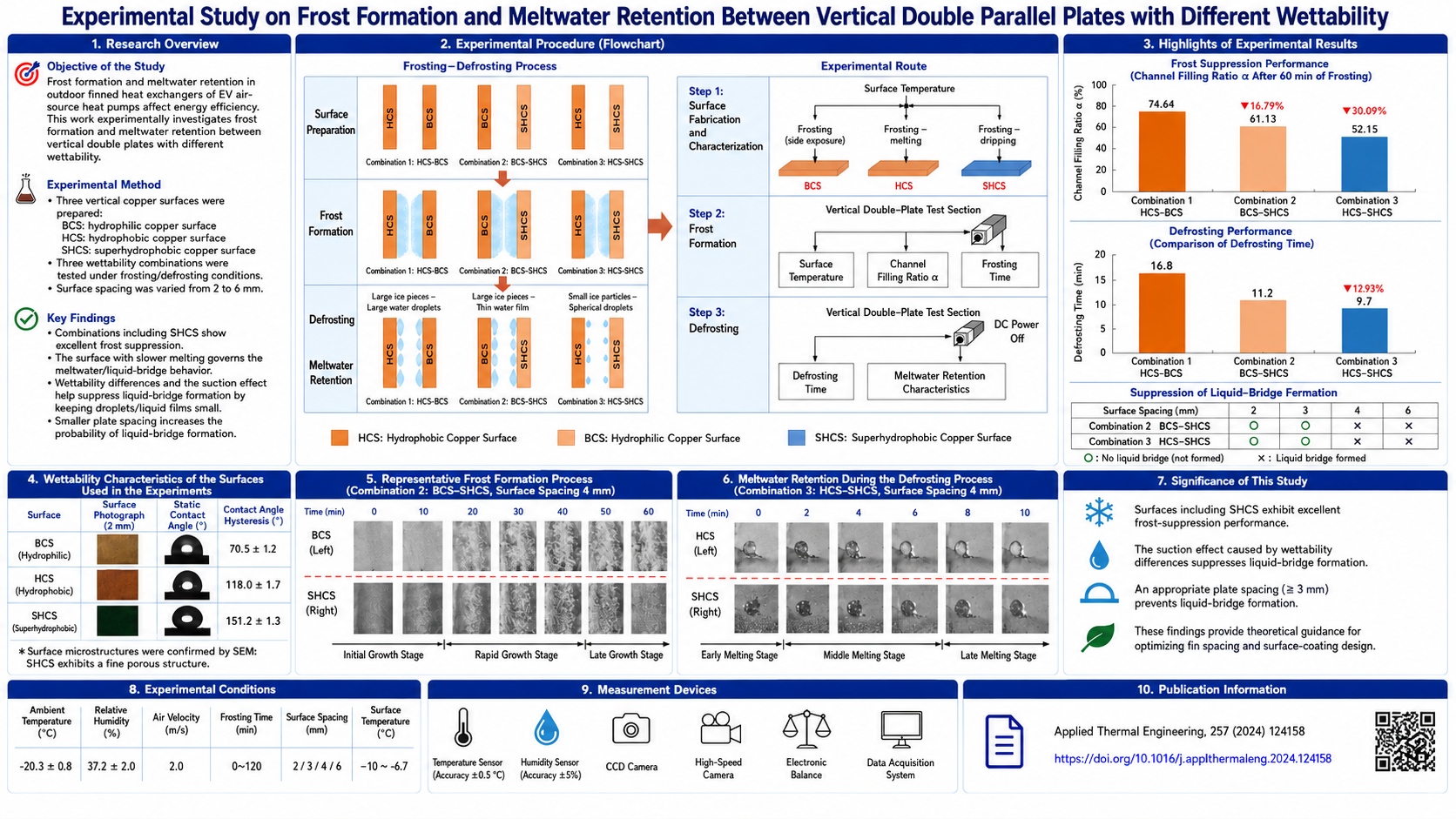
Figure: One-page graphical summary of frost formation and defrosting water retention between vertical double surfaces, including BCS, HCS, SHCS, wettability combinations, frosting–defrosting process, channel filling rate, defrosting time, meltwater retention, and liquid-bridge suppression.
Background and Objective
Air-source heat pumps are widely used for building heating, but frost formation on outdoor finned-tube heat exchangers under cold and humid conditions increases thermal resistance and blocks air flow passages.
After defrosting, retained meltwater between fins can form liquid bridges, causing flow blockage and refreezing. Therefore, both frost inhibition and defrosting water drainage are important for maintaining heat exchanger performance.
Most previous studies focused on single surfaces, whereas practical heat exchanger fins are closely spaced. This study therefore investigates frosting and defrosting water retention between two facing vertical surfaces.
Key Features of This Study
- Fin-spacing-like configuration: Two vertical parallel surfaces were used to simulate narrow fin spacing in heat exchangers.
- Three wettability surfaces: Hydrophilic BCS, hydrophobic HCS, and superhydrophobic SHCS were prepared.
- Three surface combinations: HCS–BCS, BCS–SHCS, and HCS–SHCS were compared.
- Continuous frosting–defrosting observation: Frost height, growth rate, channel filling rate, frosting completion time, defrosting time, and meltwater retention were evaluated.
- Surface spacing effect: Surface spacings of 1 mm, 2 mm, and 3 mm were tested to analyze liquid bridge formation and frost growth.
Proposed Method and Working Mechanism
1. Surface preparation and wettability characterization
BCS was prepared by polishing and cleaning copper plates. HCS was prepared by fluorosilane treatment, while SHCS was fabricated by alkaline etching to create micro/nano structures followed by low-surface-energy modification.
2. Frosting experiment between vertical double surfaces
Two surfaces were placed vertically and parallel to each other and cooled by Peltier devices. The frosting process was observed from the side using a CCD camera, and frost thickness and channel filling rate were calculated by image processing.
3. Natural defrosting and meltwater retention observation
After frosting completion, the DC power was cut off to initiate natural defrosting. Defrosting completion time and retained meltwater forms, including liquid films, coronal droplets, spherical droplets, and liquid bridges, were observed.
4. Absorption driven by wettability difference
Large liquid films on BCS and coronal droplets on HCS tend to form bridges, whereas small spherical droplets on SHCS have low adhesion and can be absorbed by moving liquid films due to surface-tension differences.
Main Findings
Future Prospects
This study provides fundamental guidance for selecting fin spacing and fin coating types in air-source heat pump heat exchangers. Combinations containing SHCS can suppress frost formation and reduce meltwater bridge formation after defrosting.
Future work should validate the findings in practical finned-tube heat exchangers under airflow, repeated frosting–defrosting cycles, long-term durability, surface contamination, and optimized wettability pattern design.
Potential Applications
The findings are useful for heat exchanger systems where frost formation and defrosting water retention are important issues.
Summary
This study experimentally evaluated frost formation and defrosting water retention between vertical double surfaces with different wettability.
Combinations including SHCS suppressed frost growth, and the HCS–SHCS combination showed advantages in frost inhibition and defrosting time. Wettability-difference-induced absorption is effective for suppressing liquid-bridge formation.
Paper Information and Links
Paper title:Experimental study on the characteristics of frost formation and defrosting water retention between vertical double surfaces with different wettability
Journal:Applied Thermal Engineering, 257 (2024) 124158
DOI:https://doi.org/10.1016/j.applthermaleng.2024.124158
Authors:Liwei Dong, Minxia Li, Chaobin Dang, Yingling Li, Jintao Niu, Qifan Wang