Research Overview
This study experimentally investigates falling film evaporation heat transfer outside a horizontal tube in a refrigeration system using low-GWP refrigerants and zeotropic refrigerant mixtures. R134a, R32, R32/R134a, and R32/R1234ze(E) were tested to clarify the effects of oil content, spray density, heat flux, evaporation temperature, and surface wettability on heat transfer coefficient (HTC) and critical heat flux (CHF).
Graphical Abstract
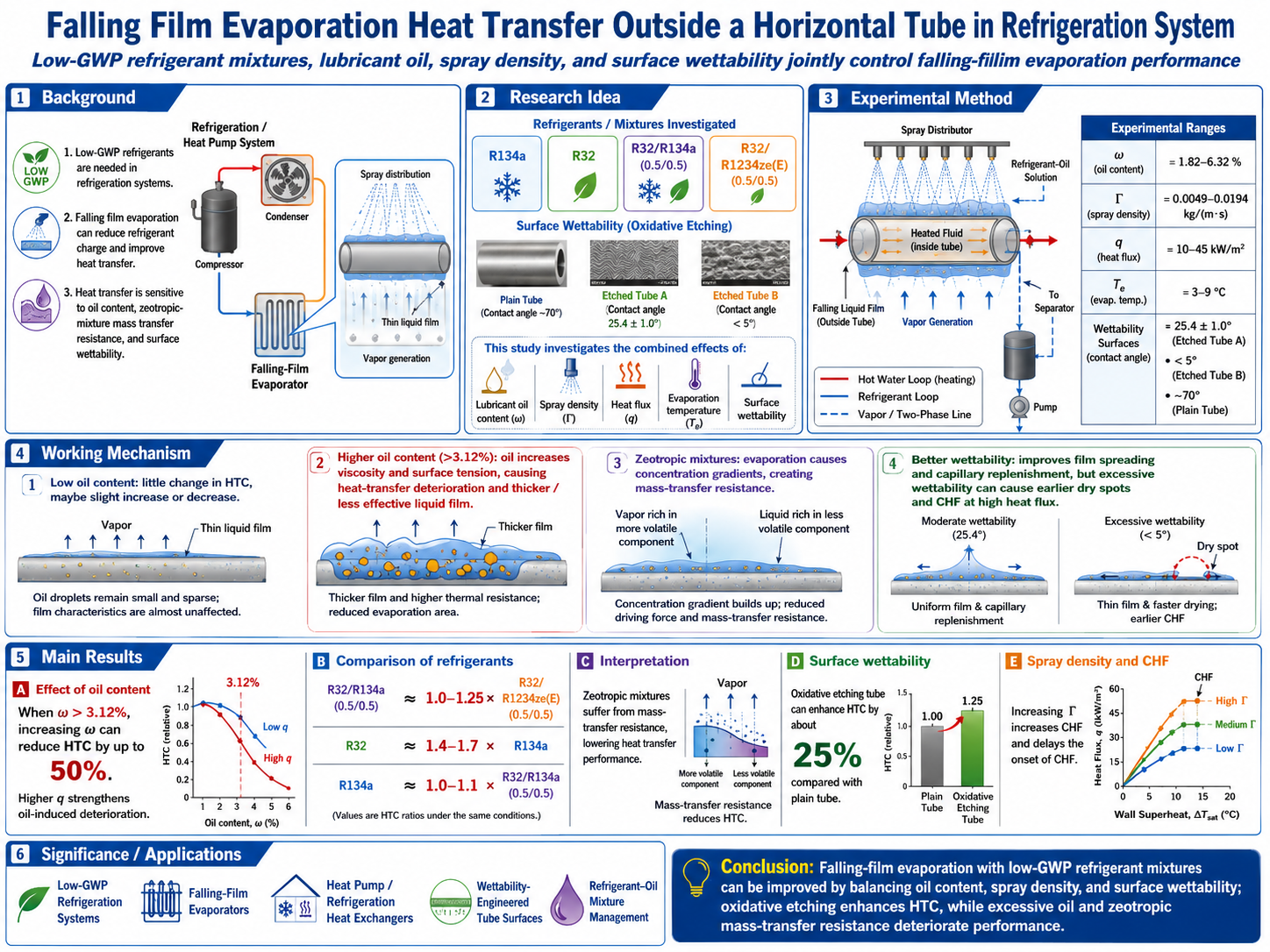
Figure: One-page graphical summary of falling film evaporation with low-GWP refrigerant mixtures, oil content, spray density, heat flux, evaporation temperature, surface wettability, HTC, CHF, and dryout behavior.
Background and Objective
Restrictions on high-GWP refrigerants have accelerated research on environmentally friendly low-GWP refrigerants and refrigerant mixtures. Reducing refrigerant charge is also important for lowering environmental impact and system cost.
Falling film evaporation supplies refrigerant as a thin liquid film on the outside of a horizontal tube. Compared with flooded evaporators, falling film evaporators can reduce refrigerant charge and achieve high heat transfer coefficients at low wall superheat.
In real refrigeration systems, lubricant oil circulates with refrigerant, and zeotropic mixtures generate concentration gradients during evaporation. These factors introduce additional heat and mass transfer resistance. This study aims to clarify how oil content, spray density, heat flux, evaporation temperature, and surface wettability affect falling film evaporation performance.
Key Features of This Study
- Evaluation in a refrigeration cycle: Falling film evaporation was tested in a refrigeration system including a compressor, condenser, expansion valve, and evaporator.
- Low-GWP mixture application: R32/R1234ze(E) and R32/R134a were investigated as representative zeotropic mixtures.
- Oil-containing refrigerant: POE oil was included to represent practical operating conditions.
- Surface wettability comparison: Oxidative etching was used to prepare tubes with different wettability, and their effects on film spreading and dryout were evaluated.
- Multi-factor analysis: Oil content, spray density, heat flux, evaporation temperature, and wettability were considered together to provide design data for FFE systems.
Proposed Method and Working Mechanism
1. Horizontal single-tube falling film experiment
A horizontal single-tube falling film evaporator was installed in a refrigeration cycle. Refrigerant was supplied from a liquid distributor onto the outer surface of the tube, while chilled water flowed inside the tube.
2. Refrigerants and operating conditions
R134a, R32, R32/R134a (0.5/0.5), and R32/R1234ze(E) (0.5/0.5) were tested. Oil content ranged from 1.82 to 6.32%, spray density from 0.0049 to 0.0194 kg/(m·s), heat flux from 10 to 45 kW/m², and evaporation temperature from 3 to 9 °C.
3. Control of surface wettability
Oxidative etching was used to prepare tubes with water contact angles of 25.4±1.0° and less than 5°. Improved wettability enhances axial spreading of liquid film and capillary replenishment.
4. HTC and CHF evaluation
The refrigerant-side HTC was obtained using heat balance on the chilled-water side and thermal-resistance separation. Dryout and CHF behavior were analyzed in relation to oil content, spray density, heat flux, and wettability.
Main Findings
Future Prospects
This study provides important experimental data for applying low-GWP zeotropic refrigerants to falling film evaporation refrigeration systems. It shows that oil content, mass transfer resistance, spray density, and surface wettability jointly determine HTC and CHF.
Future work should focus on scaling up to practical evaporators, liquid-film distribution in tube bundles, long-term oil accumulation, additional low-GWP refrigerant candidates, and optimization of surface wettability and spray density.
Potential Applications
The findings are useful for high-efficiency refrigeration and heat pump systems using low-GWP refrigerant mixtures.
Summary
This study experimentally evaluated falling film evaporation outside a horizontal tube in a refrigeration system using low-GWP mixtures, oil-containing refrigerants, and surfaces with different wettability.
High oil content strongly decreases HTC, but oil and spray density can delay CHF. Oxidative etching improves HTC, while excessive wettability may trigger earlier dryout.
Paper Information and Links
Paper title:Experimental study on falling film evaporation heat transfer outside a horizontal tube in refrigeration system
Journal:Applied Thermal Engineering, 241 (2024) 122216
DOI:https://doi.org/10.1016/j.applthermaleng.2023.122216
Authors:Qifan Wang, Dandan Su, Liang Yao, Minxia Li, Chaobin Dang, Jing Li, Xuetao Liu, Libo Yan, Jie Peng