Research Overview
This study characterizes droplet freezing on superhydrophobic aluminum surfaces with different groove microstructures. Groove arrays with spacings of 40, 60, 100, 200, 300, and 400 µm were fabricated using femtosecond laser processing and low-surface-energy coatings. By measuring water contact angle, rolling-off angle, freezing time, freezing-front evolution, supercooling time, and phase transition time, the study clarifies how groove spacing controls droplet freezing behavior and anti-icing performance.
Graphical Abstract
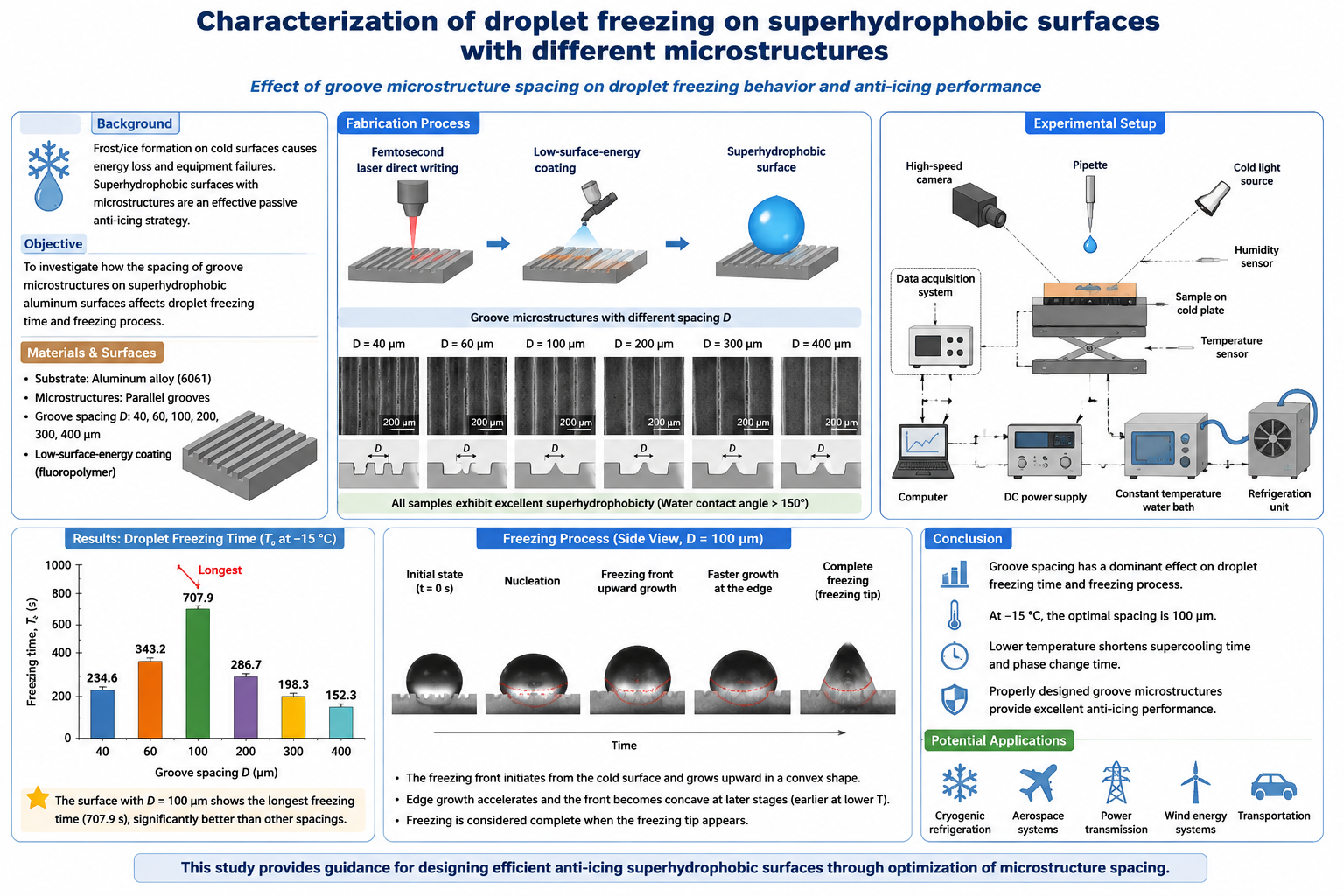
Figure: One-page summary of the background, fabrication process, experimental setup, groove-spacing effect on wettability and freezing time, freezing mechanism, key findings, and potential applications.
Background and Objective
Droplet freezing on cold surfaces is common in cryogenic refrigeration, aerospace, power transmission, wind energy, and transportation. Ice and frost formation can cause energy losses, equipment failure, and safety issues.
Superhydrophobic surfaces are promising passive anti-icing materials because they reduce the actual solid–liquid contact area and retain air pockets between the droplet and the surface. However, the effect of regular microstructure geometry, especially groove spacing, on droplet freezing has not been fully clarified. This study aims to systematically investigate how groove spacing affects freezing delay and freezing-front evolution.
Key Features of This Study
- Regular groove microstructures: Grooves with a width of 20 µm and a height of 20 µm were fabricated on 6061 aluminum alloy.
- Systematic spacing comparison: Six groove spacings were examined: D = 40, 60, 100, 200, 300, and 400 µm.
- Superhydrophobic treatment: Femtosecond laser processing was combined with an Ultra-Ever Dry low-surface-energy coating.
- Freezing visualization: Freezing of 5 µL water droplets was recorded using a high-speed camera.
- Freezing-process analysis: Freezing time, freezing-front growth, supercooling time, and phase transition time were evaluated.
Proposed Method and Working Mechanism
1. Fabrication of microstructured surfaces
The 6061 aluminum substrate was polished, cleaned, and textured using femtosecond laser direct writing. Regular groove microstructures were then coated with a low-surface-energy material to obtain superhydrophobic surfaces.
2. Wettability characterization
Water contact angle (WCA) and rolling-off angle (RA) were measured for each sample. The surface with a groove spacing of 100 µm exhibited the largest contact angle.
3. Droplet freezing experiment
A 5 µL deionized water droplet was placed on each surface. The main freezing experiment was conducted at a cold surface temperature of −15 °C, with additional tests at −10 °C and −20 °C to compare supercooling and phase transition behavior.
4. Freezing-front analysis
The solid–liquid interface inside the droplet, called the freezing front, was tracked during freezing. Its transition from convex upward growth to a concave shape and the formation of the freezing tip were analyzed.
Main Findings
Future Prospects
This study demonstrates that groove microstructure spacing strongly affects droplet freezing time, freezing-front behavior, supercooling time, and phase transition time. A groove spacing of 100 µm provided a favorable balance between contact angle and air-pocket retention, resulting in excellent freezing delay.
Future work can further examine groove shape, groove height, hierarchical micro/nanostructures, coating durability, and repeated freeze–thaw cycles to improve anti-icing performance under practical operating conditions.
For applications such as heat exchanger fins, aircraft surfaces, and power transmission equipment, further evaluation should include condensation, frost growth, icing, and deicing under realistic environmental conditions.
Potential Applications
The results can support the design of passive anti-icing and frost-resistant surfaces for low-temperature devices and outdoor systems.
Summary
This study fabricated superhydrophobic aluminum surfaces with different groove spacings using femtosecond laser processing and a low-surface-energy coating.
The 100 µm-spaced surface showed the maximum water contact angle and the longest freezing time, indicating that geometric optimization of microstructures is effective for improving passive anti-icing performance.
Paper Information and Links
Paper title:Characterization of droplet freezing on superhydrophobic surfaces with different microstructures
Journal:Energy & Buildings, 327 (2025) 115109
DOI:https://doi.org/10.1016/j.enbuild.2024.115109
Authors:Xu Han, Dan Zhang, Haikun Zheng, Wei Sheng, Xiaoru Hao, Xiaozhuan Chen, Chaobin Dang, Mengjie Song