Research Overview
This study experimentally and theoretically investigates the melting characteristics of cubic ice cubes with different trace air contents under natural convection conditions. Ice mass was varied from 20 g to 50 g, and air content was varied from 0 to 3.9 vol.%. The melting behavior of clear ice and bubble ice was compared, and a natural-convection melting model was developed to predict the complete melting time within an error of ±20%.
Graphical Abstract
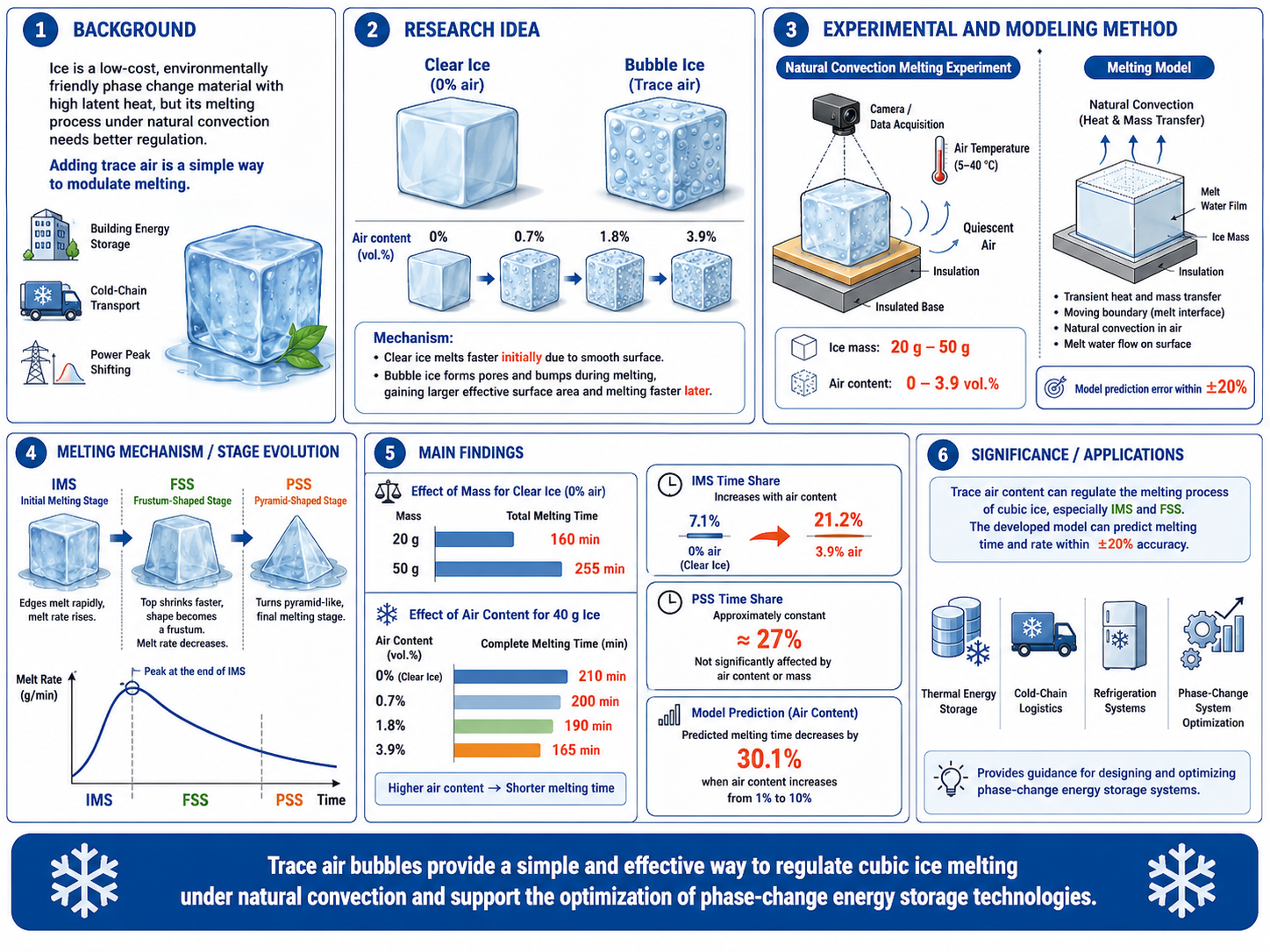
Figure: One-page graphical summary of cubic ice as a phase change material, clear ice and bubble ice, natural convection melting experiment, melting model, three melting stages, air-content-dependent melting time regulation, and applications in phase-change energy storage.
Background and Objective
Ice is a representative phase change material with low cost, high latent heat, and environmental friendliness. It is widely used in building thermal storage, cold-chain transport, refrigeration systems, and power peak shifting.
However, the low heat transfer capability of phase change materials limits storage and release rates. Conventional enhancement methods, such as adding metal or porous materials, may involve complex preparation.
The objective of this study is to clarify whether adding trace air into ice can simply and effectively modulate the natural-convection melting process of cubic ice, thereby providing guidance for phase-change energy storage design.
Key Features of This Study
- Ice as a phase change material: The study analyzes the fundamental melting process of ice, a low-cost and environmentally friendly PCM.
- Focus on trace air content: Cubic ice with air contents of 0, 0.7, 1.8, and 3.9 vol.% was compared.
- Natural convection condition: Ice cubes were placed on an insulated base and melted in quiescent air.
- Three-stage melting process: The melting process was divided into the initial melting stage (IMS), frustum-shaped stage (FSS), and pyramid-shaped stage (PSS).
- Melting model: A natural-convection melting model considering shape change and bubble-induced effective area increase was proposed.
Proposed Method and Working Mechanism
1. Preparation of clear and bubble ice
Cubic ice samples with different trace air contents were obtained by cutting ice from different positions after freezing. Clear ice had nearly 0% air content, while bubble ice contained 0.7–3.9 vol.% air.
2. Natural-convection melting experiment
Cubic ice was placed on insulated cotton in a constant-temperature chamber. Shape change was recorded from the top and side using cameras, and mass loss was measured using an electronic balance.
3. Stage classification
The melting process was divided into IMS, FSS, and PSS based on the time when the melting rate reached its maximum and when the ice shape transformed into a pyramid.
4. Natural-convection melting model
A melting model was developed by considering natural convection between ice and air, latent heat of melting, shape evolution, and an effective heat-transfer-area coefficient caused by air bubbles.
Main Findings
Future Prospects
This study shows that trace air bubbles can be used to regulate ice melting under natural convection. As melting proceeds, bubbles create surface pores and bumps, increasing effective heat-transfer area and accelerating the later melting process.
Future work should extend the concept to other phase change materials, controlled bubble size and distribution, container melting, forced convection conditions, and practical thermal storage or cold-chain systems.
Potential Applications
The findings are useful for the design of ice-based and PCM-based thermal energy storage and cold energy systems.
Summary
This study experimentally investigated natural-convection melting of cubic ice with different trace air contents and divided the melting process into IMS, FSS, and PSS.
Increasing air content slows melting at the beginning, but as melting proceeds, surface pores and bumps increase effective heat-transfer area and shorten the total melting time.
Paper Information and Links
Paper title:Experimental study on the melting characteristics modulation of cubic ice cubes with different trace air contents under natural convection condition
Journal:Journal of Energy Storage, 102 (2024) 114186
DOI:https://doi.org/10.1016/j.est.2024.114186
Authors:Yonghui Liang, Mengjie Song, Jun Shen, Chaobin Dang, Carlos Di Prinzio, Xuan Zhang