Research Overview
This study proposes a novel constant-pressure control method for molecular dynamics simulations of CO2 and CO2/PEC4 lubricant nucleation boiling. Conventional fixed-volume models cannot keep the liquid-phase pressure constant during boiling, which makes it difficult to reproduce isobaric boiling behavior. By placing a movable cover plate at the top of the liquid phase, this work controls the pressure during boiling and clarifies the effects of pressure and lubricant concentration on bubble nucleation, bubble growth, molecular diffusion, and oil-film formation.
Graphical Abstract
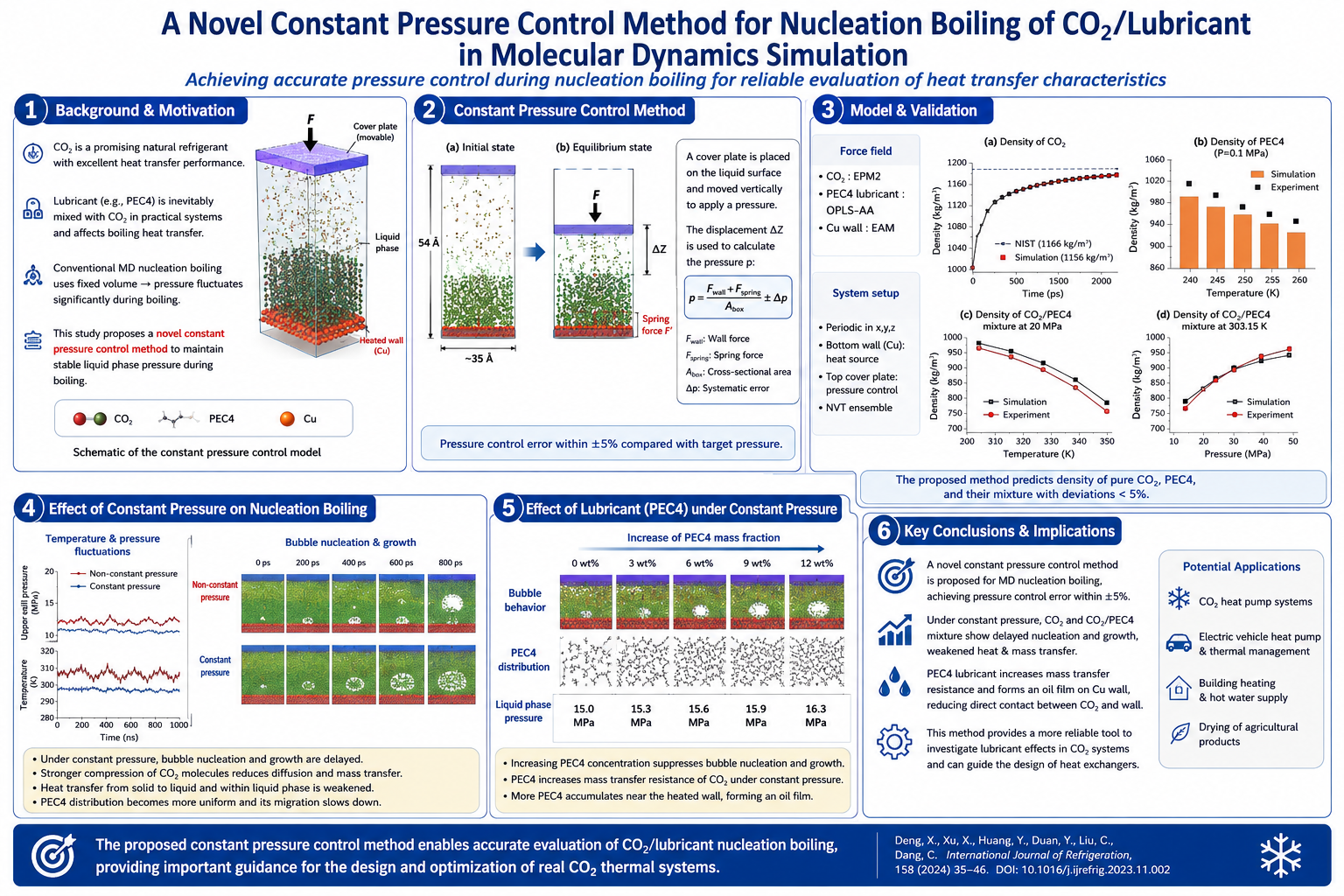
Figure: One-page summary of the background, proposed pressure-control model, validation method, nucleation boiling behavior, lubricant concentration effect, and possible applications.
Background and Objective
CO2 is a promising natural refrigerant with GWP=1 and ODP=0, and it is widely considered for heat pumps, electric vehicle air conditioning, building heating, hot-water supply, and drying systems. In practical systems, compressor lubricant is inevitably carried into the refrigerant loop and affects boiling heat transfer and mass transfer in heat exchangers.
Lubricant is a highly viscous and non-phase-change component. Its presence may modify CO2 nucleation, bubble growth, molecular diffusion, and wall-contact behavior. This study therefore aims to clarify the molecular-scale mechanisms of CO2/lubricant nucleation boiling using a constant-pressure molecular dynamics simulation framework.
Key Features of This Study
- Constant pressure control: A movable cover plate is placed above the liquid phase to control the liquid pressure during boiling.
- Molecular dynamics analysis: Nucleation boiling of pure CO2 and CO2/PEC4 mixtures is investigated at the molecular scale.
- Lubricant effect: The effects of PEC4 mass fraction on bubble nucleation, bubble growth, diffusion, and oil-film formation are clarified.
- Realistic boiling condition: The method provides a closer representation of isobaric boiling than conventional fixed-volume models.
Proposed Method and Working Mechanism
1. Pressure control with a movable cover plate
A constant downward force is applied to a solid cover plate above the liquid phase. The plate behaves like a piston and imposes controlled pressure on the liquid region.
2. Nucleation boiling under constant pressure
Pure CO2 and CO2/PEC4 mixtures are simulated to compare bubble nucleation, bubble growth, temperature distribution, self-diffusion, and lubricant distribution.
3. Lubricant migration and oil-film formation
PEC4 molecules interact more strongly with the Cu wall than CO2 molecules and accumulate on the heated surface during boiling, forming an oil film that hinders direct contact between CO2 and the wall.
Main Findings
Future Prospects
The proposed constant-pressure control method provides a more realistic molecular dynamics framework for analyzing CO2/lubricant nucleation boiling under near-isobaric conditions. It enables reliable evaluation of how lubricant contamination affects heat transfer performance from a microscopic perspective.
Future work can extend this method by systematically changing lubricant type, lubricant mass fraction, wall structure, pressure, and temperature conditions. Such studies will help clarify the mechanisms of boiling heat transfer degradation and oil-film formation in CO2 thermal systems.
The method can also be applied to other refrigerant/lubricant mixtures, providing molecular-level guidance for heat exchanger design and optimization.
Potential Applications
The findings are useful for the design and optimization of thermal systems using CO2 as a working fluid.
Summary
This study proposed a movable-cover-plate method to improve pressure control in molecular dynamics simulations of nucleation boiling.
The method enabled more realistic analysis of CO2 and CO2/PEC4 nucleation boiling and revealed how lubricant affects bubble nucleation, bubble growth, diffusion, and oil-film formation.
Paper Information and Links
Paper title:A novel constant pressure control method for nucleation boiling of CO2/lubricant in molecular dynamics simulation
Journal:International Journal of Refrigeration, 158 (2024) 35–46
DOI:https://doi.org/10.1016/j.ijrefrig.2023.11.002
Authors:Xianqiang Deng, Xiaoxiao Xu, Yongfang Huang, Yongxiang Duan, Chao Liu, Chaobin Dang