Research Overview
This study experimentally investigates the influence of POE lubricant oil on CO2 nucleate pool boiling heat transfer. Boiling curves, heat transfer coefficients, and bubble images were measured for pure CO2 and CO2/POE mixtures under different evaporation temperatures, heat fluxes, and oil concentrations. The results show that a small amount of oil can enhance heat transfer at low evaporation temperature by promoting nucleation, while high evaporation temperature or high oil concentration causes heat transfer deterioration due to oil enrichment at the vapor–liquid interface and small bubble clusters.
Graphical Abstract
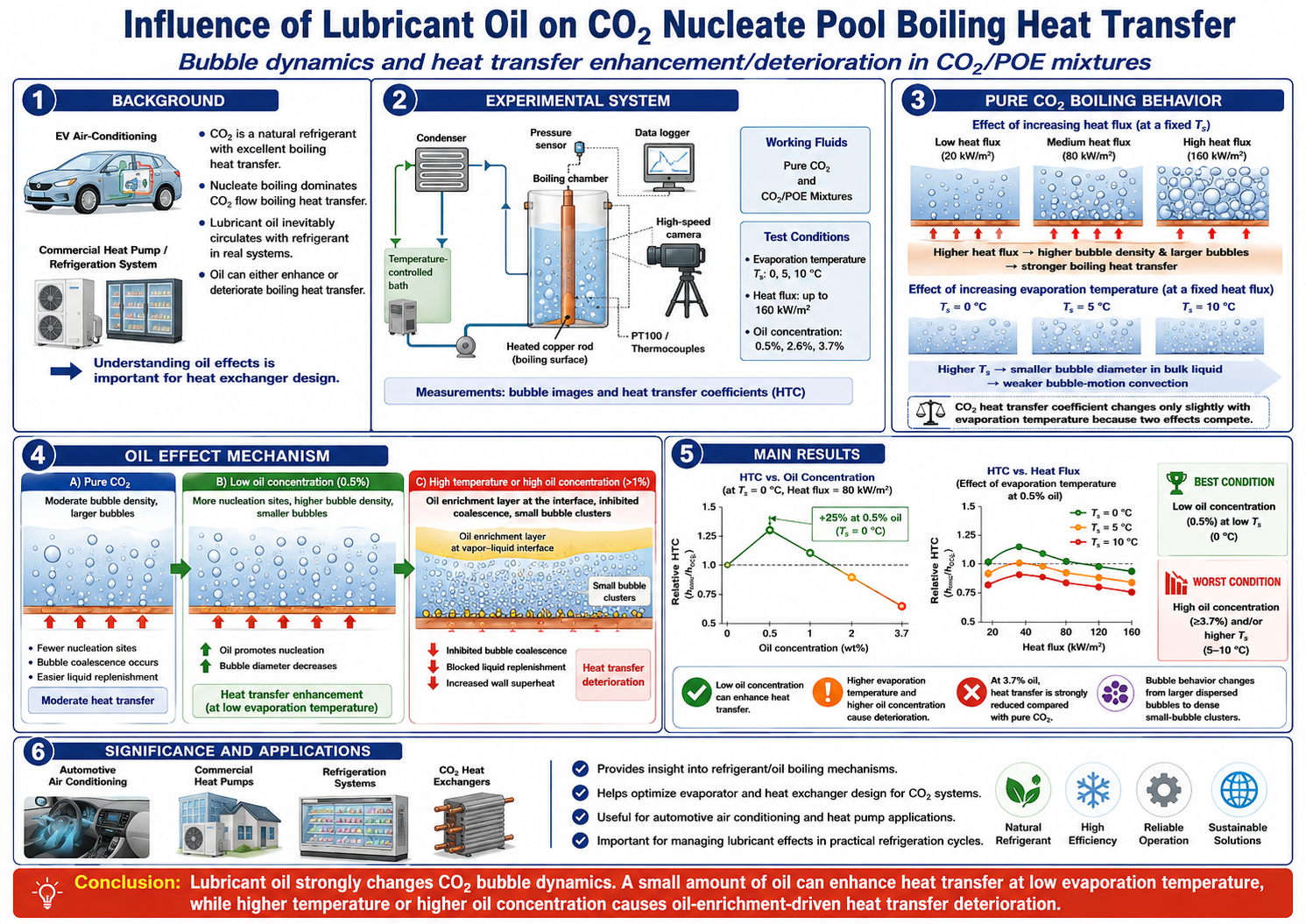
Figure: One-page graphical summary of the CO2/POE nucleate pool boiling experiment, pure CO2 boiling behavior, oil-induced changes in bubble density and bubble diameter, oil-enrichment layer formation, and the conditions for heat transfer enhancement or deterioration.
Background and Objective
CO2 is an environmentally friendly natural refrigerant with excellent heat transfer and two-phase flow characteristics. It is widely considered for automotive air conditioning, commercial heat pumps, and refrigeration systems. Since nucleate boiling is a dominant heat transfer mechanism in CO2 flow boiling, understanding CO2 nucleate boiling is important for evaporator and heat exchanger design.
In practical refrigeration cycles, lubricant oil inevitably circulates with the refrigerant from the compressor into heat exchangers. Lubricant oil has much higher viscosity and surface tension than CO2 and can change bubble nucleation, bubble departure, bubble coalescence, interfacial mass transfer, and wall superheat.
The objective of this study is to clarify how evaporation temperature, heat flux, and oil concentration influence heat transfer coefficients and bubble dynamics in CO2/POE nucleate pool boiling, thereby providing a fundamental basis for CO2 heat exchanger design.
Key Features of This Study
- Focus on natural refrigerant CO2: The study targets CO2 boiling heat transfer relevant to automotive air conditioning and commercial heat pumps.
- Direct nucleate pool boiling experiments: The fundamental mechanism dominating CO2 flow boiling is investigated through controlled pool boiling tests.
- POE lubricant-oil effect: CO2/POE mixtures with oil concentrations of 0.5%, 2.6%, and 3.7% were tested.
- Bubble visualization: High-speed imaging was used to observe bubble density, bubble diameter, and small bubble clusters.
- Enhancement and deterioration mechanisms: The study distinguishes the nucleation-promoting effect of small oil addition from the heat-transfer deterioration caused by oil enrichment at higher temperature or concentration.
Proposed Method and Working Mechanism
1. CO2 nucleate boiling experiment
A quartz-glass boiling chamber, heated copper rod, condenser, thermostatic bath, pressure sensor, PT100, and thermocouples were used to measure nucleate pool boiling of CO2 and CO2/POE mixtures.
2. Experimental conditions
Evaporation temperatures of 0 °C, 5 °C, and 10 °C were tested, with heat flux up to about 160 kW/m². POE oil concentrations were 0.5%, 2.6%, and 3.7%, and the results were compared with pure CO2.
3. Heat transfer coefficient calculation
Heat flux was calculated from the temperature distribution inside the copper rod using Fourier’s law, and the heat transfer coefficient was obtained from the wall-to-liquid temperature difference.
4. Bubble visualization
A high-speed camera was used to record bubble images during boiling. Oil-induced changes in bubble density, bubble diameter, coalescence, and cluster formation were linked to heat transfer performance.
Main Findings
Future Prospects
This study shows that lubricant oil does not simply deteriorate CO2 boiling heat transfer. Under suitable low-temperature and low-concentration conditions, oil can promote nucleation and enhance heat transfer.
Future work should extend the investigation to flow boiling, different lubricant types, oil return and distribution control, detailed measurement of interfacial oil enrichment, prediction of local oil concentration in CO2 heat exchangers, and practical evaporator design.
Potential Applications
The findings are useful for designing heat exchangers in CO2-based refrigeration, air-conditioning, and heat pump systems.
Summary
This study measured nucleate pool boiling of pure CO2 and CO2/POE mixtures and clarified the effects of oil concentration and evaporation temperature on bubble dynamics and heat transfer coefficients.
A small amount of oil enhances heat transfer at low evaporation temperature by promoting nucleation, whereas higher temperature or higher oil concentration causes heat transfer deterioration due to oil enrichment and small bubble clusters.
Paper Information and Links
Paper title:Experimental investigation on the influence of lubricant oil on CO2 nucleate pool boiling heat transfer characteristics
Journal:Applied Thermal Engineering, 260 (2025) 124975
DOI:https://doi.org/10.1016/j.applthermaleng.2024.124975
Authors:Yongfang Huang, Xiaoxiao Xu, MingWen Luo, Chaobin Dang